
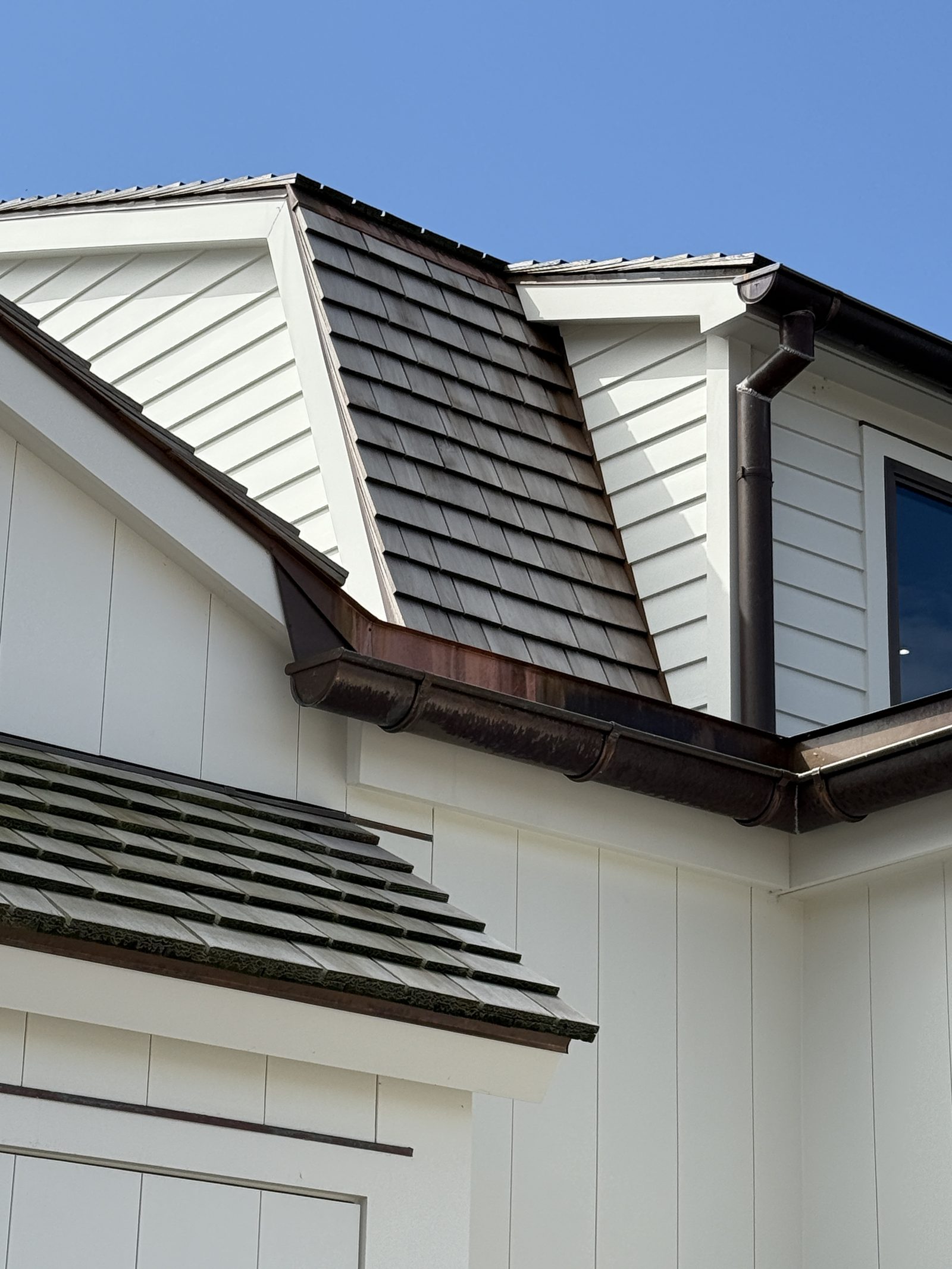
Standard copper weathers green. This is, for most traditional New England properties, exactly the right outcome — the verdigris of old copper gutters and flashing is part of the visual language of the well-maintained historic house. But there are buildings and situations where the green is wrong, where the masonry is light enough that the copper runoff stains it visibly, or where the architecture is formal enough that the slow transition from bright to brown to green reads as unresolved rather than distinguished. For these situations, lead-coated copper exists.
Lead-coated copper weathers to a consistent, stable grey — the grey of old lead, soft and matte, without the blue-green of verdigris. On a formal Federal period house with light limestone or pale brick, it is the correct roofing and flashing metal. It does not stain adjacent materials. It does not call attention to itself. It becomes part of the building's material palette in the way that a well-chosen mortar color does — present but not dominant.
The grey of lead-coated copper is different from the grey of zinc or aluminum. It has warmth in it, a slight brown undertone that comes from the copper beneath the lead coating as it ages. After ten or fifteen years it has a quality of surface that no other roofing metal achieves — dense, quiet, authoritative.
Lead-coated copper is standard copper sheet — typically sixteen-ounce for flashing and gutter applications — with a thin coating of lead bonded to both faces. The lead coating is typically 1/8 to 1/4 pound per square foot. It provides the corrosion resistance and weathering stability of lead while retaining the workability, strength, and longevity of copper as the structural material.
The lead coating also provides a degree of self-sealing at solder joints and overlaps that bare copper does not. This makes lead-coated copper somewhat more forgiving in installation, particularly in complex flashing conditions at dormers, chimneys, and valleys where watertight connections are critical.
Lead-coated copper behaves essentially like standard copper in service — the same thermal expansion characteristics, the same requirement for expansion accommodation in installation, the same longevity when correctly installed and maintained. The lead coating does not significantly change the structural behavior of the material. It changes the weathering behavior, substituting the stable grey of lead oxidation for the blue-green of copper carbonate.
Lead-coated copper does not stain adjacent materials the way bare copper does. The runoff from lead-coated copper is chemically different and does not produce the blue-green staining on masonry and painted wood that is the primary objection to standard copper in certain applications. This is its functional advantage over standard copper, distinct from the aesthetic difference.
Lead-coated copper is the correct specification on light-colored masonry buildings — limestone, pale brick, light stucco — where copper staining would be visible and problematic. It is the correct specification on historic properties where the existing metal roofing and flashing is lead-coated copper and replacement must match the original. It is the correct specification on formal buildings where the verdigris green would read as too casual for the architectural character.
Standard copper is correct everywhere else. The green it develops is not a problem to be solved. It is the material arriving at its permanent state, and on most traditional New England houses, that state is correct and beautiful. Lead-coated copper is a specific solution to a specific situation, not a general improvement on standard copper.
Specify sixteen-ounce lead-coated copper, 1/8 pound lead coating per face, for flashing and gutter applications. Fabricated and installed by a sheet metal contractor experienced in architectural copper work. The installation requirements are the same as standard copper — expansion accommodation, correct soldering, proper integration with roofing and masonry — and the same level of craft is required.
Sixteen-ounce lead-coated copper, 1/8 pound lead coating per face, for flashing and gutters on light masonry buildings where copper staining is a concern, on historic properties where the existing metal is lead-coated, and on formal buildings where the grey patina is architecturally appropriate. Standard copper everywhere else. Lead-coated copper is a specific solution to a specific situation. The green of standard copper is not a problem to be solved.
Something missing from the archive?
Suggest a material →