
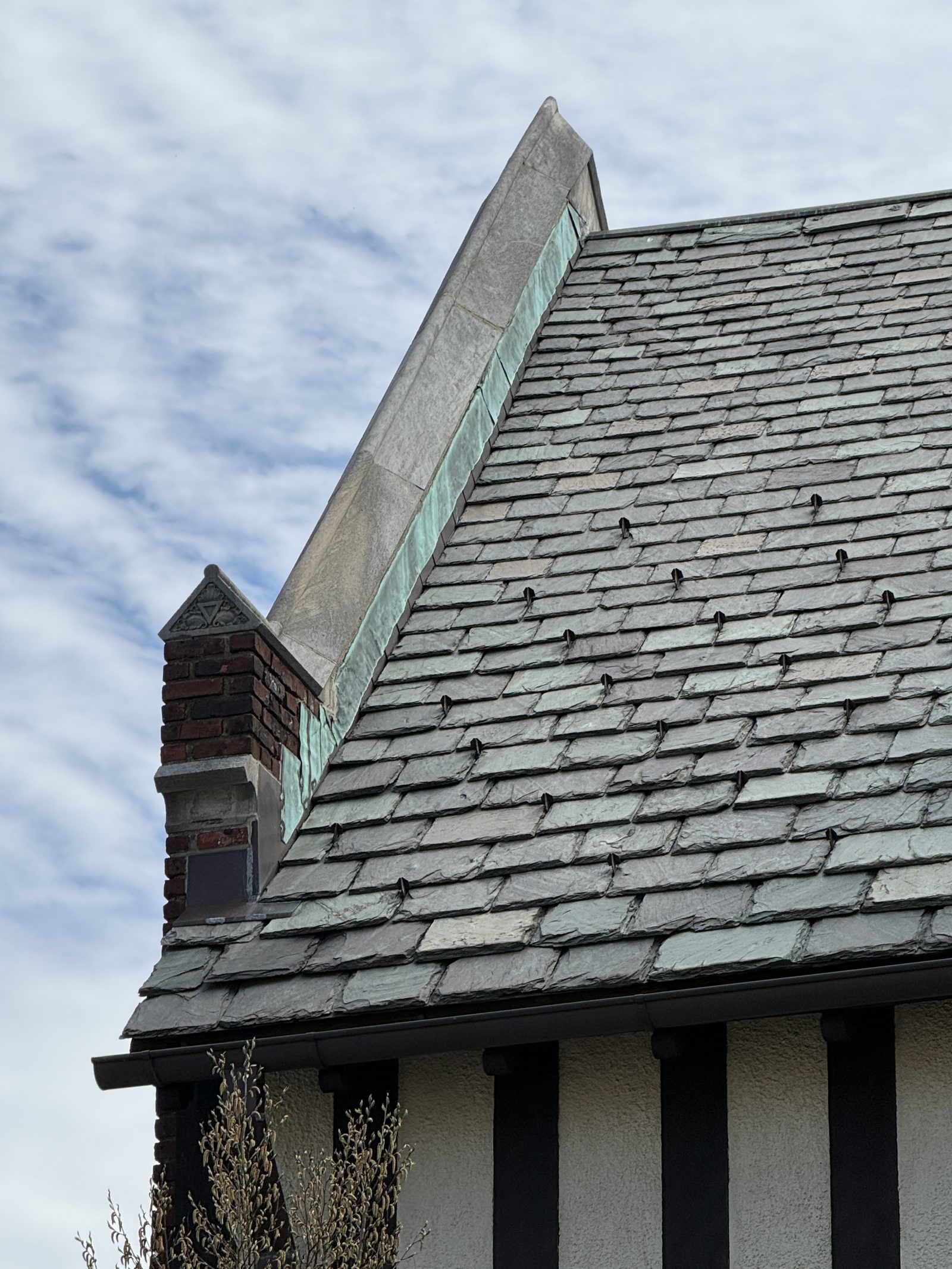
Moss and lichen on a New England roof generate more anxiety than they deserve. Neither is, by itself, evidence of a failing roof. Both are the natural biological response to the specific conditions of a north-facing slope or a shaded surface in a humid climate. The question is not whether they are there. It is what they indicate about the roof's condition and what, if anything, requires attention.
Moss is green, soft, and three-dimensional — it builds up from the surface as a spongy mat. It holds moisture. Lichen is flat, grey-green to orange-yellow, and crusty — it grows by chemical bonding to the surface and cannot be brushed off without damaging what it grows on. On a slate roof, lichen is nearly always benign. On a cedar shingle roof, moss accumulation indicates a drainage or ventilation problem.
Moss is a bryophyte — a small plant that requires moisture and shade to establish. On roofing, it grows most aggressively on north-facing slopes, in the shadow of trees, and in climates with consistent humidity. Lichen is a symbiotic organism of algae and fungi, extremely slow-growing, that colonizes stone and mineral surfaces. On slate, lichen is part of the roof's natural history. On cedar, it is not typical and indicates unusual surface conditions.
On slate roofing: lichen is essentially harmless. It does not penetrate the stone or damage it. It can be left indefinitely without consequence. Moss on slate is more concerning — the mat holds moisture against the slate surface, which can accelerate slate face scaling in soft weathering grades. On cedar shingle roofing: moss accumulation indicates moisture retention, which accelerates decay. Identify and correct the cause — typically shade or inadequate ventilation — before treating.
Lichen on an old slate roof is evidence of age, stability, and undisturbed surface. It is not a problem. Treating it aggressively with biocides or pressure washing damages the slate surface and is worse than leaving the lichen alone. The moss on a cedar shingle roof is the thing to address, through shade management and ventilation correction, not through repeated chemical treatment of the symptom.
This entry is about management, not specification. For moss removal from cedar roofing: zinc strips at the ridge, which release zinc ions in rainwater that inhibit moss growth. For aggressive moss removal: low-pressure soft washing with a dilute sodium hypochlorite solution. Do not pressure wash any roofing material.
Lichen on slate roofing: leave it. Moss on slate: monitor; remove only if accumulation is significant and the slate is a soft weathering grade. Moss on cedar shingle roofing: identify and correct the cause — shade, ventilation — before treating. Zinc strip at the ridge of cedar roofs as preventive maintenance. No pressure washing of any roofing material.
Something missing from the archive?
Suggest a material →