
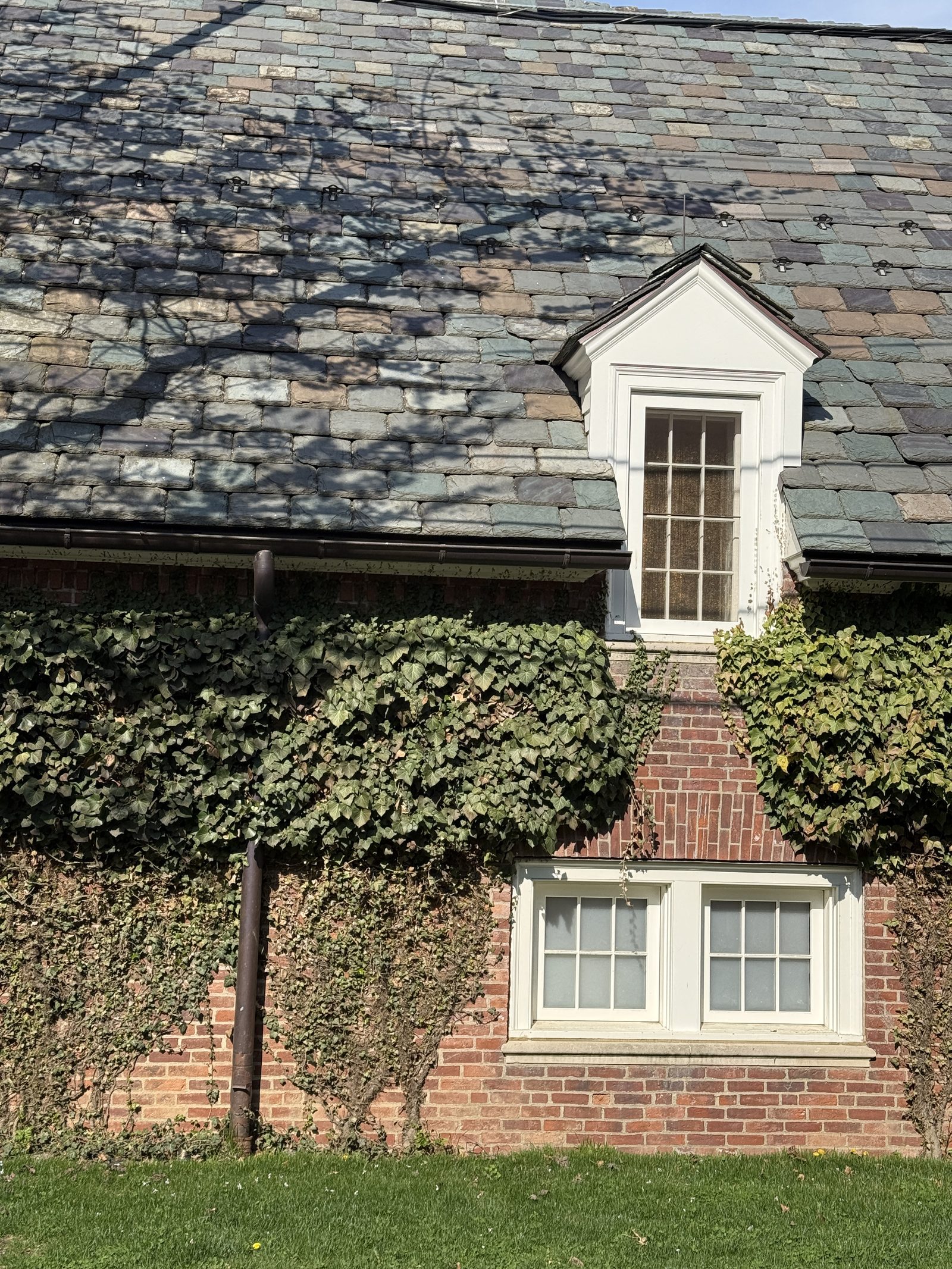
A slate roof, correctly installed, outlasts the building it covers. There are slate roofs in New England that have been in service for 150 years. There are slate roofs in Europe that have been in service for 400. The material does not deteriorate in a New England climate. What fails is the flashings, the fasteners, and occasionally the slates themselves if the wrong grade was specified or the wrong installation method was used. The roof itself, the stone, is essentially permanent.
Slate reads as stone on a roof — dense, flat, and completely still in a way that no asphalt shingle approximates. The color range is wide: Vermont slate runs from grey-green to purple to mottled grey and green. Pennsylvania slate is primarily grey to blue-grey. Vermont unfading grades hold their color indefinitely. Vermont weathering grades shift in color over the first decade and then stabilize. The texture is smooth at the surface and slightly rough at the edges where the slate was split.
Roofing slate is quarried slate split to uniform thickness — 3/16" to 1/4" for standard applications — and cut to rectangular dimensions. Standard American sizes range from 10"x6" to 24"x14", with 12"x6", 14"x8", and 16"x10" being the most common residential sizes. Vermont slate quarries produce unfading (hard) grades and weathering grades. Pennsylvania Peach Bottom slate was historically one of the finest grades available and is no longer commercially quarried. Spanish and Chinese imported slate is available but should not be specified on traditional New England buildings.
Hard unfading Vermont slate does not deteriorate in New England conditions. Soft or weathering grades develop surface scaling over decades, which is a known behavior and not a failure if specified correctly. Flashings — copper is the correct flashing material — are the maintenance item on a slate roof. Expect to replace copper step and counter flashings every 50 to 75 years. The slate itself needs attention only when individual slates crack or slip from broken fasteners.
On a traditional New England building, a slate roof is correct in a way that no other material is. It has weight. It has history. It has a service life that asks nothing of the owner for decades at a time. The decision to replace a sound slate roof with asphalt because the flashings leaked is one of the most common and most costly errors made on traditional New England buildings.
Vermont Structural Slate, Glendyne (Canadian grey slate), and several Spanish producers supply the North American market. For traditional New England work, specify Vermont slate by grade: #1 Unfading (hard, holds color) or Vermont Weathering (will shift in color and soften over decades). Installation by a slate roofing contractor — not a general roofing contractor — is essential.
Vermont #1 Unfading slate, 3/16" to 1/4" thickness, copper nails, copper flashings, for roofing on traditional New England residential buildings. No imported slate. No asphalt underlayment in contact with the slate — specify 30-lb felt or copper-compatible synthetic. A slate roof correctly installed is a once-per-building-lifetime specification.
Something missing from the archive?
Suggest a material →