
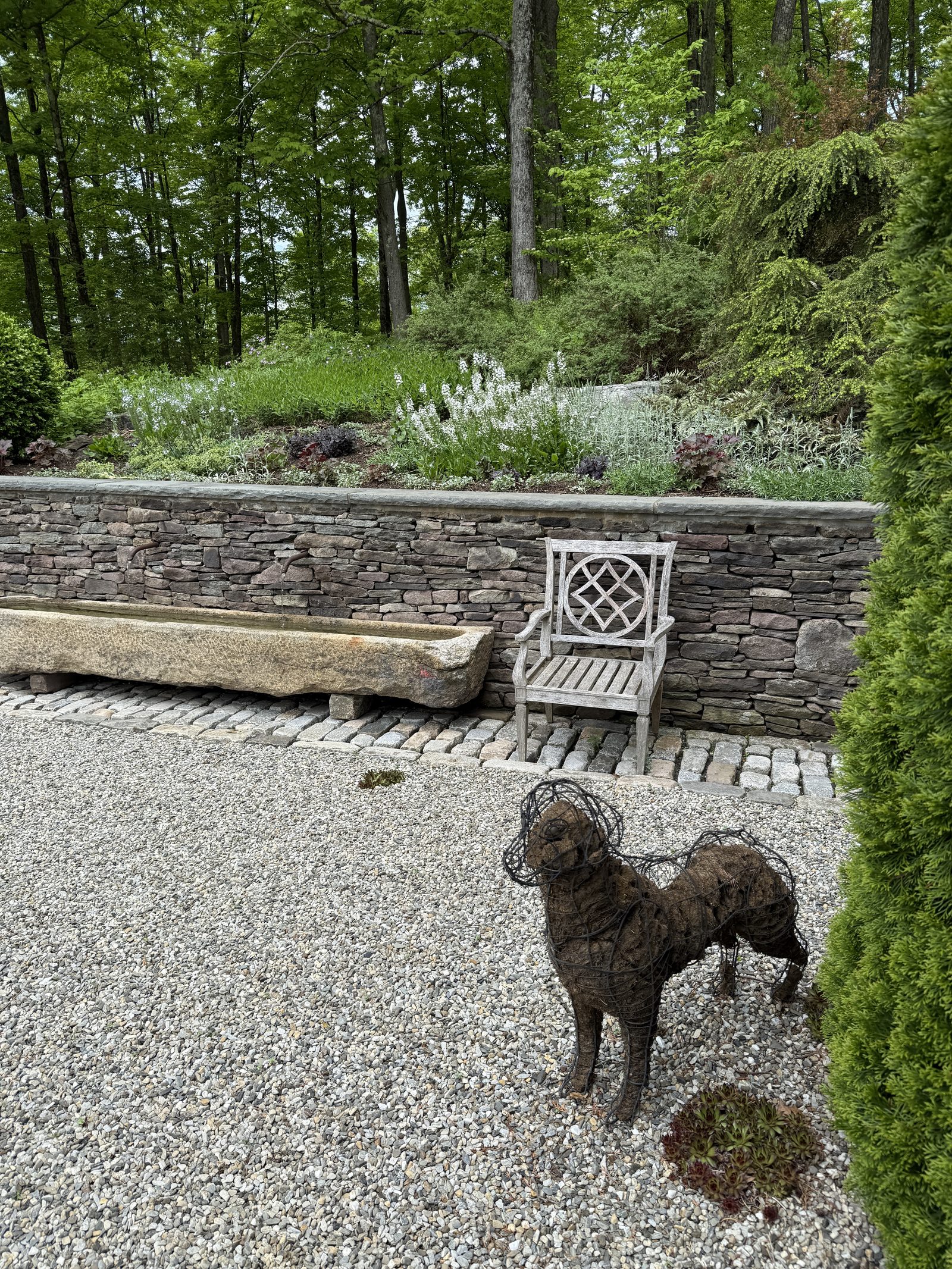
The pea gravel driveway without Belgian block edging is not finished. It is a pile of gravel loosely arranged in the approximate shape of a driveway, and within a season it will confirm this by migrating into the lawn, collecting in low spots, and losing whatever definition it had. Belgian block is what gives the gravel driveway its permanence. The relationship between the two materials is not decorative. It is structural.
Belgian block sits at the boundary between the managed and the natural, between the gravel surface and the lawn or planted edge. When it is right it is almost invisible — you register the edge as a fact rather than as a material. The block is low to the ground, tight to the gravel, and its color has long since settled into something close to the stone it contains. When it is wrong it announces itself. The joints are too wide, the color too uniform, the setting too high above the gravel plane.
Old Belgian block, pulled from city streets and relaid, is the best available material. It carries the wear of use — rounded corners, varied color, the particular grey-black of stone that has been rained on ten thousand times. New block is acceptable but reads as newer for longer.
Belgian block is a rectangular paving stone, traditionally granite or basalt, cut to roughly uniform dimensions. The standard size is approximately 4 by 4 by 8 inches, though reclaimed material varies. Granite Belgian block is the correct material for New England applications — the basalt commonly used in urban paving has a bluer, darker tone that reads differently against the warm grey of native pea gravel.
The name is historical rather than geographic. What is called Belgian block in the United States is closely related to what Europeans call sett paving or cobblestone, though true cobblestones are rounded rather than cut. The distinction matters because rounded cobblestones are not appropriate for driveway edging — they do not lock together tightly enough to hold a gravel perimeter.
Properly installed Belgian block does not move. It is set in a compacted gravel base with concrete haunching on the outside face to lock it in place against the lateral pressure of vehicles driving close to the edge. Without concrete haunching the block will eventually migrate outward under load and the gravel will follow it.
The top of the Belgian block should sit flush with or very slightly above the gravel surface — no more than half an inch proud. Higher than this and it becomes a wheel hazard. Lower and it loses its function as a containment edge. The joint between blocks should be tight, filled with stone dust or polymeric sand, and as narrow as the variation in block size permits.
The alternatives to Belgian block for gravel edging are instructive. Steel edging is clean and precise but reads as contemporary and landscape-architectural rather than traditional. Pressure-treated timber edging fails, always, within a decade. Plastic edging is not a consideration. Granite cobbles work but their rounded shape makes tight jointing difficult. Belgian block is the material that has edged gravel driveways and stable yards in New England for a hundred and fifty years because it is correct for the application in every dimension — scale, color, durability, and the way it reads against the gravel it contains.
Source reclaimed granite Belgian block from salvage yards or stone suppliers who stock antique material. New granite block is available from quarry suppliers and is acceptable where reclaimed material is not available or where consistency of size is important for a formal application.
Install in a compacted crusher run base, 4 inches minimum. Concrete haunching on the outside face, below grade. Joints filled with stone dust, swept in and compacted. Top of block flush to slightly proud of finished gravel surface.
Reclaimed granite Belgian block, approximately 4 by 4 by 8 inches, for driveway and terrace perimeter edging. Set in compacted crusher run base with concrete haunching on outside face. Joints tight, filled with stone dust. Top of block flush to half inch proud of gravel surface. No plastic edging. No timber edging. No cobblestone substitutes. The gravel driveway is not finished without it.
Something missing from the archive?
Suggest a material →