
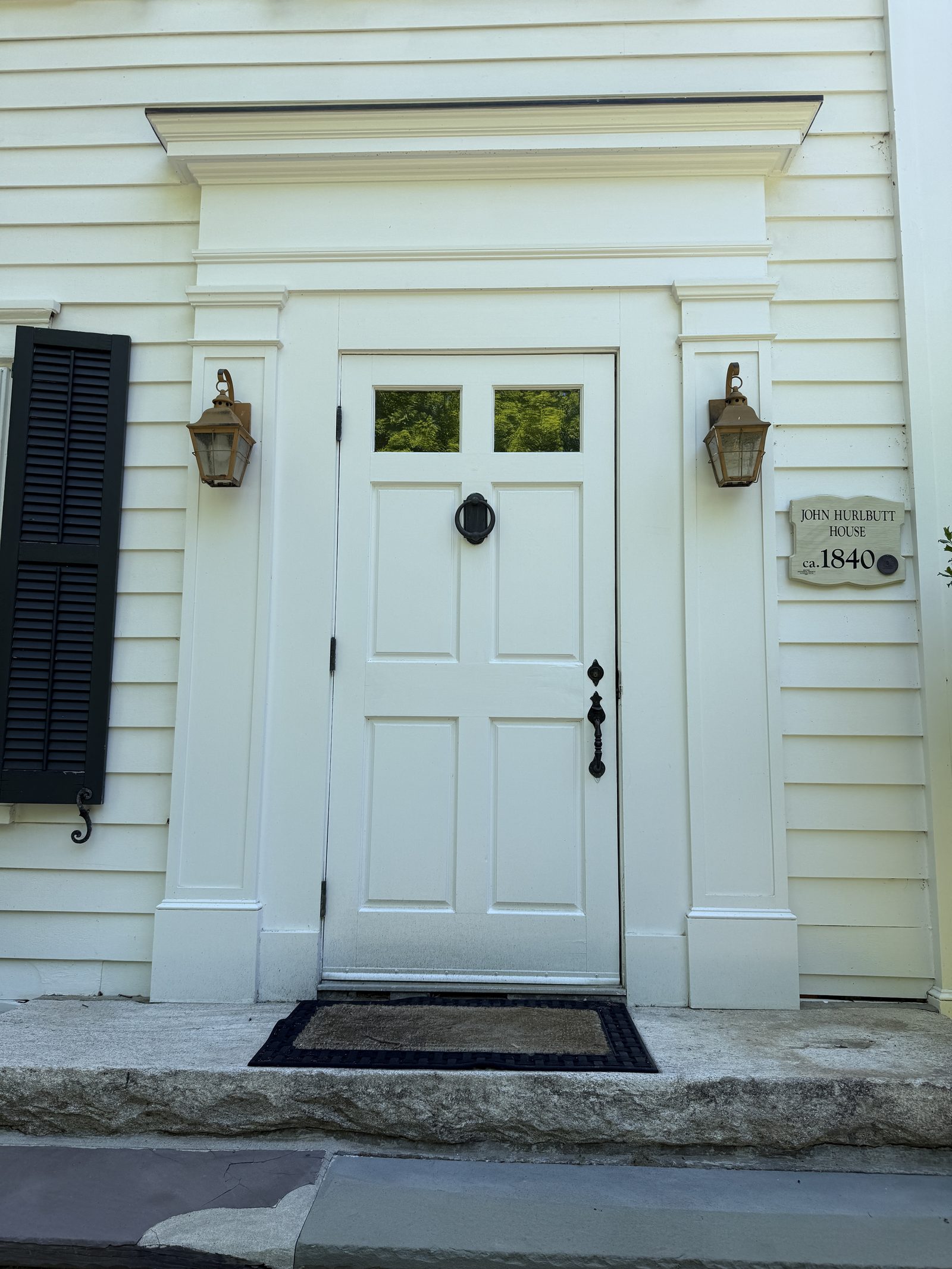
The window openings of historic New England masonry houses are framed in granite. The sill below the window, the lintel above it, and sometimes the jambs on either side are all cut stone, grey against the warm red of the brick or the varied tone of the fieldstone, and they give the window its weight and its permanence. This is not decoration. It is structure, and the granite endures long after the windows it frames have been replaced multiple times.
Old granite sills on a Federal period house have been worn by two hundred years of rain and sill-sitting. The corners have softened. The surface has developed the particular texture of stone that has been weathered in place rather than cut yesterday. The color has deepened from the fresh grey of new granite to something richer — still grey, but with more depth, with the surface variations that accumulate over centuries of freeze-thaw and biological activity. New granite sills on a restoration project are immediately identifiable as new. They require time to settle into the building.
Granite sills and lintels are cut from the same quarry stone as granite curbing and steps. The specifications differ in the precision required — sills must be cut to exact dimensions to fit window openings, and the top surface must slope slightly outward to shed water away from the window frame. This slope is typically 1/8 inch per foot, subtle enough to be invisible but sufficient to prevent water from ponding at the base of the window.
The correct finish for a traditional granite sill is a smooth sawn or lightly honed surface on the top and face, with a drip edge cut into the underside of the sill projection. The drip edge — a narrow groove cut into the stone approximately half an inch from the outer edge of the underside — causes water to drip free of the sill rather than running back under it toward the masonry joint. This detail is often omitted on restoration projects and is one of the primary causes of water damage at window openings.
Lintels spanning window openings in brick buildings are typically cut from single pieces of granite for openings up to approximately five feet. For wider openings, steel lintels are appropriate and historically used, with a granite fascia piece applied to the face to maintain the visual continuity of the stone surround.
Granite in this application is as permanent as any building material in the New England climate. The stone itself does not deteriorate under normal conditions. The mortar bed it sits in will eventually need repointing, and the flashing at the junction between the sill and the window frame will need maintenance, but the stone is not the vulnerable element. It outlasts everything around it.
Where granite sills fail, they fail at the joint — between the stone and the masonry below it, or between the stone and the window frame above it. Water infiltrates these joints, freezes, and expands. Over cycles of this, the joint opens further and the infiltration increases. The solution is not new stone. It is correctly detailed flashing and properly maintained joints.
For restoration of existing stone sills and lintels, repair rather than replace wherever possible. Individual pieces that have cracked or deteriorated can be replaced to match the original. The match should be as close as possible in color and finish — this typically requires sourcing from the same regional quarry type as the original material, or using reclaimed granite from a salvaged source.
For new work on traditional masonry buildings, specify granite sills and lintels cut from local New England quarry stock. Smooth sawn top surface with a slight outward slope. Drip edge on underside. Bed in Type O lime mortar. Flash at all joints between stone and window frame with copper or lead-coated copper. The flashing is not optional — it is what keeps the detail watertight over the life of the building.
Granite sills and lintels from New England quarry stock, smooth sawn top surface with 1/8 inch per foot outward slope. Drip edge cut into underside, half inch from outer edge. Bed in Type O lime mortar. Copper or lead-coated copper flashing at all joints between stone and window frame. For restoration, match original in color and finish — reclaimed granite where possible. The stone is permanent. The joints and flashing require maintenance.
Something missing from the archive?
Suggest a material →