
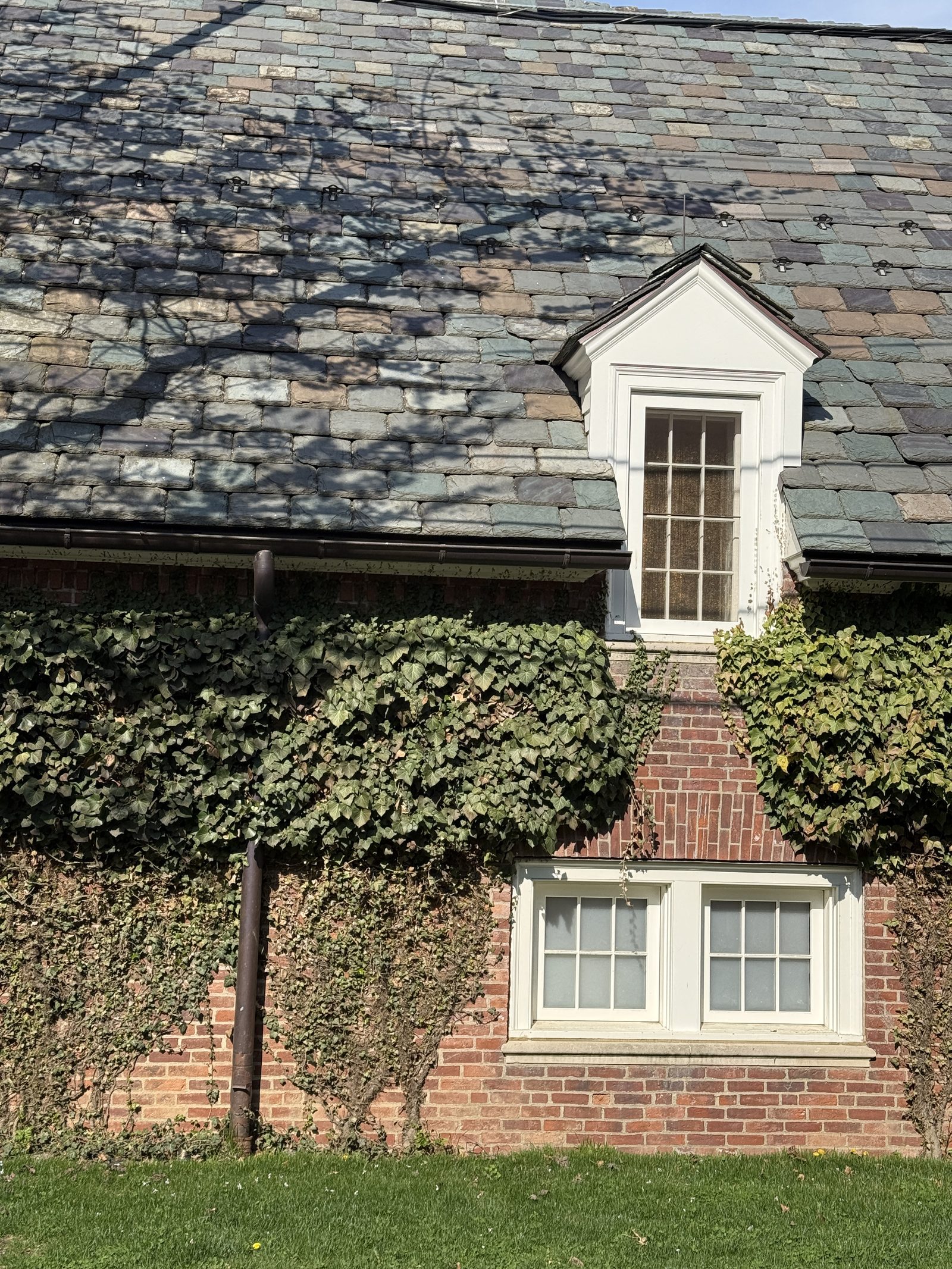
A slate roof on a New England house is not a luxury. On a house built before 1930 it was the standard roofing material for any building of consequence, and on many that were not. Vermont and New York quarries supplied the region for two centuries. The roofs that remain from that era, where they have been maintained rather than replaced, are still sound. Some of them are over a hundred years old. The asphalt shingles that replaced them will be on their third or fourth installation by now.
Slate has a color and a texture that no manufactured material approximates at any distance. The surface is not uniform — each slate is slightly different in color, in the way it reflects light, in the small variations of its cleft face. A slate roof in rain goes almost black. In dry winter light it is the grey of a frozen pond. In afternoon sun certain slates catch the light and the roof seems to shift slightly, as if it is breathing.
Old slate, where the lichen has established itself along the edges and in the low courses, is one of the most beautiful surfaces in the New England landscape. The lichen does not harm the stone. It marks time.
Roofing slate comes primarily from Vermont, New York, and Pennsylvania. Vermont slate is the standard for New England work — it quarries in a range of colors from grey-green to purple-grey to the mottled grey that most people picture when they think of a New England slate roof. Pennsylvania blue-black slate is harder and longer-lasting but has a darker, more urban quality that does not always suit the vernacular of Connecticut and Vermont farmhouses. New York slate falls between the two.
Slate is graded by expected life. S1 slate, the highest grade, is rated for over 75 years. S2 for 40 to 75 years. S3 for 20 to 40 years. On a traditional New England house, S1 is the only appropriate specification. The cost difference between grades is small relative to the total cost of a slate roof installation, and the difference in longevity is measured in generations.
Thickness matters. Standard roofing slate is 3/16 inch. Heavier slate at 1/4 inch or more is used on steeper pitches and formal applications. Thicker slate has more thermal mass, holds up better in freeze-thaw conditions, and reads as more substantial from the ground.
A well-installed slate roof requires almost no maintenance for the first fifty years. The slates themselves do not fail — the fasteners do. Copper nails are the correct fastener for slate. Galvanized nails will rust through in twenty to thirty years in a New England climate, causing slates to slip and fall before the stone itself shows any deterioration. A historic slate roof that has been repointed with galvanized nails is not a properly maintained slate roof. It is a slate roof that will need repair again in twenty years.
When individual slates crack or slip, they can be replaced without disturbing the surrounding installation. This is one of the fundamental advantages of slate over any membrane or shingle roofing — it is a repairable system rather than a replaceable one. A slate roof maintained correctly has no theoretical end of life.
Slate is heavy. A slate roof weighs four to eight times what an asphalt shingle roof weighs. Historic New England houses were built to carry this load. Modern houses built to conventional framing standards may not be without structural reinforcement. This must be assessed before any slate installation on new construction.
The case for slate on a traditional New England house is not primarily aesthetic, though the aesthetic case is overwhelming. It is economic over any time horizon longer than twenty years. An asphalt shingle roof costs less to install and must be replaced every fifteen to twenty-five years. A slate roof costs more to install and lasts a century or more with minimal maintenance. On a house that will be owned and maintained over generations, slate is the less expensive choice.
The visual case requires less argument. Asphalt shingles on a traditional New England house read as a compromise. Slate reads as the material the house was always meant to have, which in most cases is exactly true.
Specify Vermont S1 roofing slate for traditional New England applications. Color selection depends on the house — grey-green Vermont slate suits painted clapboard and cedar shingle houses equally well. Purple-grey reads as more formal and suits Federal and Greek Revival buildings. Avoid Pennsylvania blue-black on vernacular houses where it looks imported rather than regional.
Copper nails only. No exceptions. The nails are a small fraction of the total installation cost and the difference in longevity is thirty to fifty years.
Engage a slater with documented experience in natural slate, not a roofer who occasionally installs slate. The techniques are different and the difference in quality is immediately visible in the finished roof.
Vermont S1 roofing slate, grey-green or grey-purple depending on house and context. Copper nails throughout. Installed by a slater experienced in natural slate. Individual slates replaced as needed — the system is maintained, not replaced. Copper nails are not optional. The slate itself will outlast every other decision made on the project.
Something missing from the archive?
Suggest a material →