
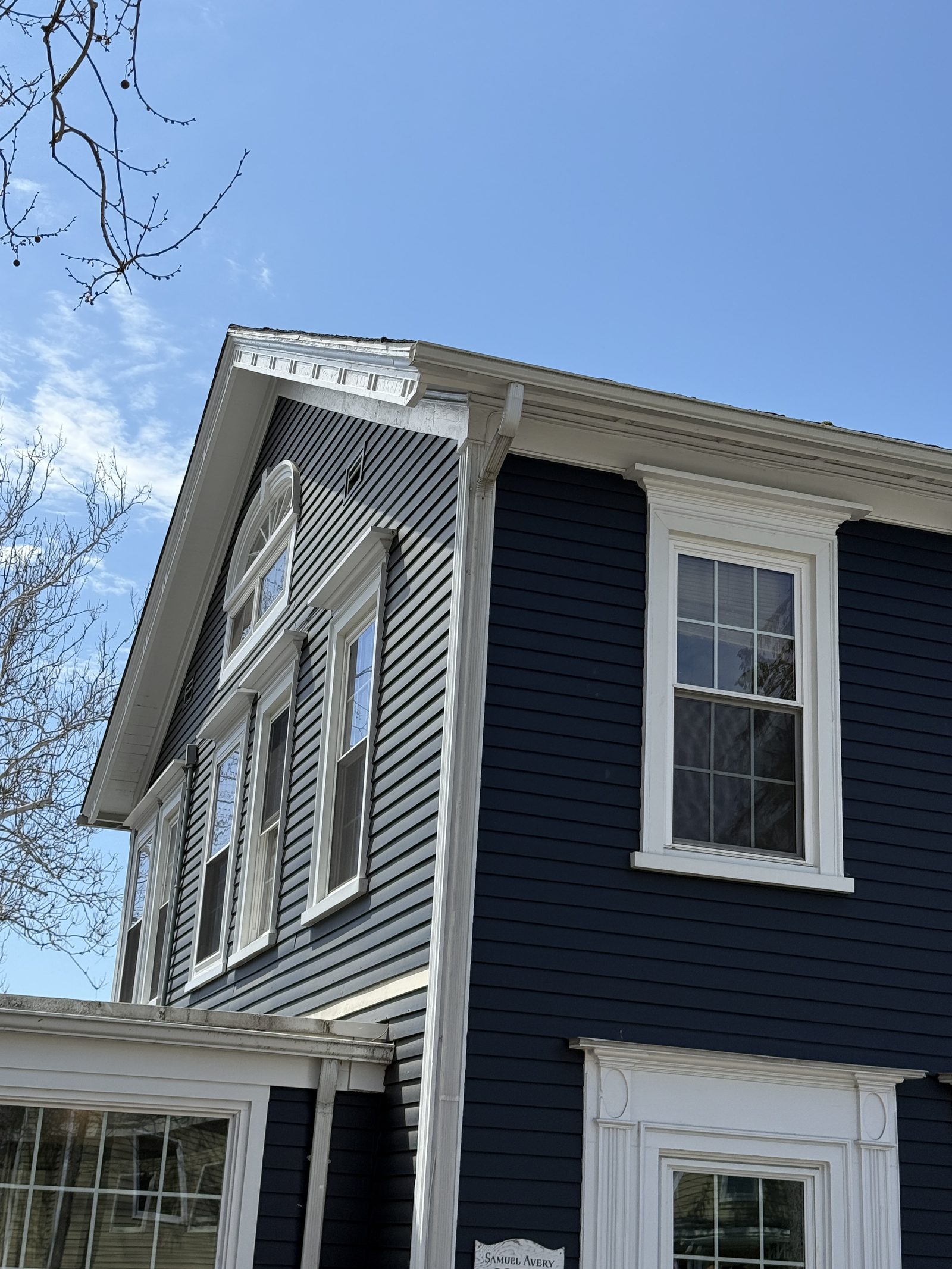
Almost every exterior shutter installed in the last fifty years is decorative — fixed to the wall, sized incorrectly, and incapable of closing over the window it pretends to protect. The original shutter was a working element. It closed. It was sized to cover the window completely when closed. It was hinged. Its hardware was substantial. The difference between a real shutter and a fake one is immediately visible to anyone who looks.
Painted wood, in a color that is either the body color of the house or a darker accent — traditionally dark green, black, dark red, or dark grey on a white or light house. The shutter has vertical stiles and horizontal rails with either louvers, raised panels, or board-and-batten construction. It sits flat against the wall when open and covers the window completely when closed. The width of each shutter is exactly half the window width.
A correct exterior shutter is built from clear white pine or western red cedar, 1-1/8" to 1-1/4" thick, with mortise-and-tenon or pinned construction at the joints. Louver shutters have fixed or operable louvers at approximately 3-inch spacing. Hardware is cast iron or forged steel: strap hinges set into the masonry or exterior casing, with a shutter dog or holdback to keep them open against the wall. Vinyl and composite shutters are not appropriate on traditional buildings.
Wood shutters require painting on the cycle of the rest of the exterior wood. They must be painted on all faces — including the back and the edge grain — to prevent moisture infiltration. Louver shutters accumulate paint at the louver joints over repainting cycles and eventually need stripping. Hardware must be kept tight and the hinge pintles checked for security annually. A working shutter, properly maintained, lasts as long as the building.
The decorative shutter is a lie the building tells about itself. It signals that the builder or owner did not understand what shutters are for, and that signal is visible from the street. Correctly sized, correctly hung, and correctly hardwared shutters give the windows a frame that closes, and they demonstrate that the building was built with the knowledge of what its parts are for.
Custom wood shutters are available from millwork shops throughout New England. Measure window width and height precisely, specify material (clear white pine or cedar), shutter type (louver, panel, board-and-batten), and hardware (cast iron strap hinges, shutter dogs). Order shutters sized to cover the window when closed: each shutter width = window opening width divided by two.
Clear white pine or cedar exterior shutters, 1-1/8" minimum thickness, sized to cover window opening completely when closed. Cast iron or forged steel strap hinges, pintle-mounted to masonry or casing. Shutter dogs to hold open position. Painted on all faces. The size is not decorative preference. It is the specification for a shutter that is actually a shutter.
Something missing from the archive?
Suggest a material →