
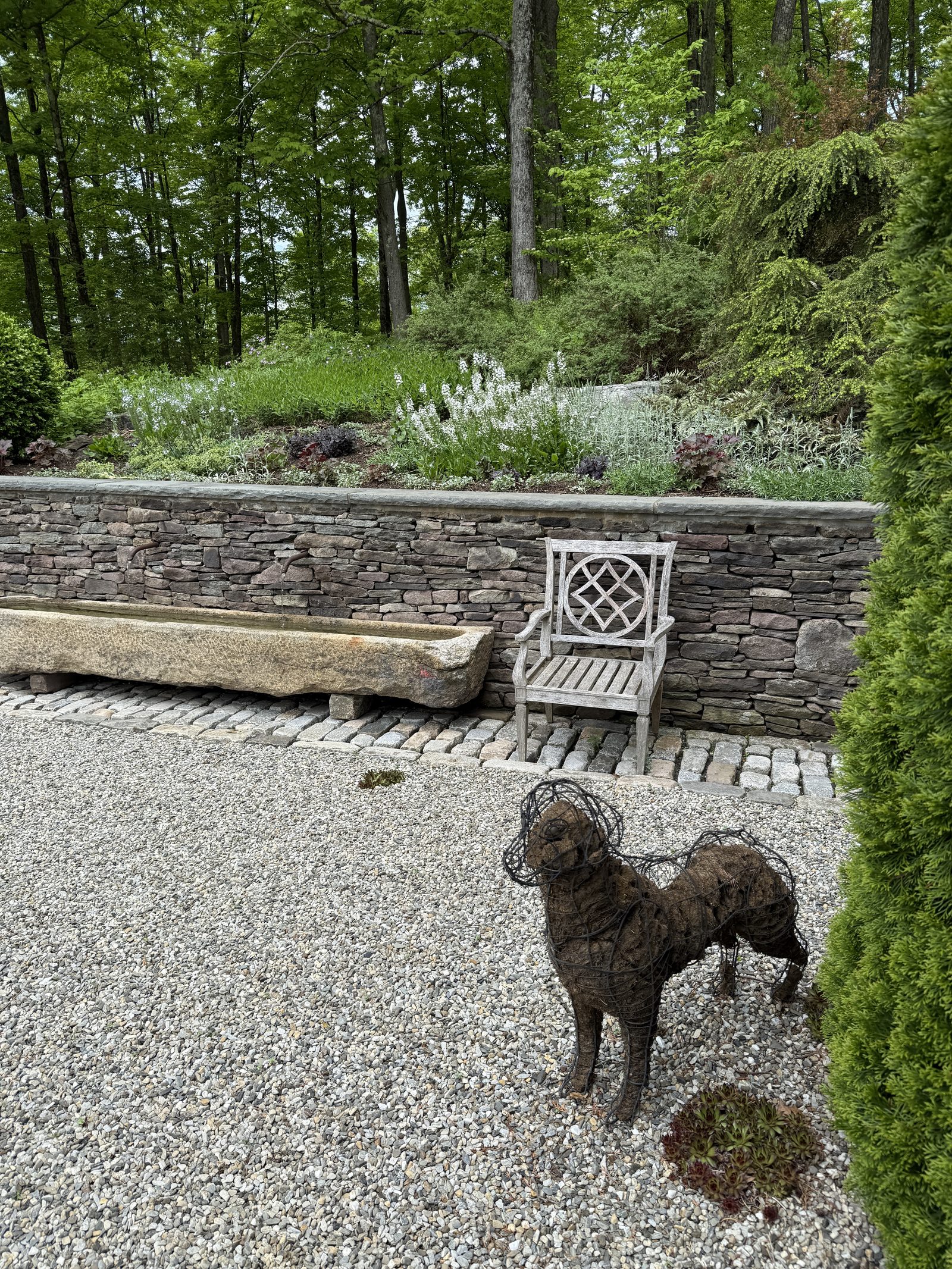
A gravel path is simple. Gravel, contained, at grade. The failures are predictable and almost always the same: wrong gravel grade, no edging, insufficient depth. The result is a path that migrates at the edges, grows weeds through the middle, and turns to mud in wet weather. The correct path does none of these things.
A correct gravel path is firm underfoot — not loose, not muddy, not weedy. The surface is even, slightly compacted, with a gentle crown or cross-slope to shed water. The edges are defined — a steel edging set flush with the surface, or a stone or brick edging set slightly proud. The gravel itself reads as a material choice, not as a default.
Gravel paths in a New England context are typically one of three materials: native pea gravel (river-washed, 3/8" grade, warm grey to buff), crushed granite or trap rock (angular, grey to blue-grey, 3/8" to 1/2"), or Vermont marble chips (white, angular, 3/8", formal garden settings). The base is compacted crusher run, minimum 4 inches. The surface gravel is 2 to 3 inches deep over the base. Edging is 3/16" steel, set flush with the finished surface, or stone or brick edging for formal garden settings.
A correctly built gravel path drains freely, compacts slightly with use, and does not shift significantly within its edging. Weeds germinate in the gravel surface but are easily pulled when young. A landscape fabric layer under the gravel — sometimes specified to suppress weeds — creates a different problem: it prevents the gravel from compacting into the base, resulting in a path that shifts underfoot. Skip the fabric.
Gravel is the historically correct path material for kitchen gardens, cutting gardens, and informal garden paths at traditional New England properties. It is permeable, durable, and visually appropriate in a way that concrete and asphalt are not. The choice of gravel type establishes the register of the garden: pea gravel for informal, marble chips for formal, crushed stone for utilitarian.
From stone yards. Order base material (crusher run) and surface material separately. Calculate base at 1.25 tons per 100 square feet at 4-inch depth, surface material at 0.75 tons per 100 square feet at 2-inch depth. Steel edging from a landscape supplier. Install base first, compact, then install edging, then apply surface gravel and rake level.
Four-inch compacted crusher run base, 2-inch surface dressing of specified gravel, 3/16" steel edging flush with finished surface. No landscape fabric. Surface material appropriate to setting: pea gravel for informal and kitchen garden paths, Vermont marble chips for formal garden paths, crushed granite for utilitarian service paths. This is a path that holds its grade and its edges.
Something missing from the archive?
Suggest a material →