
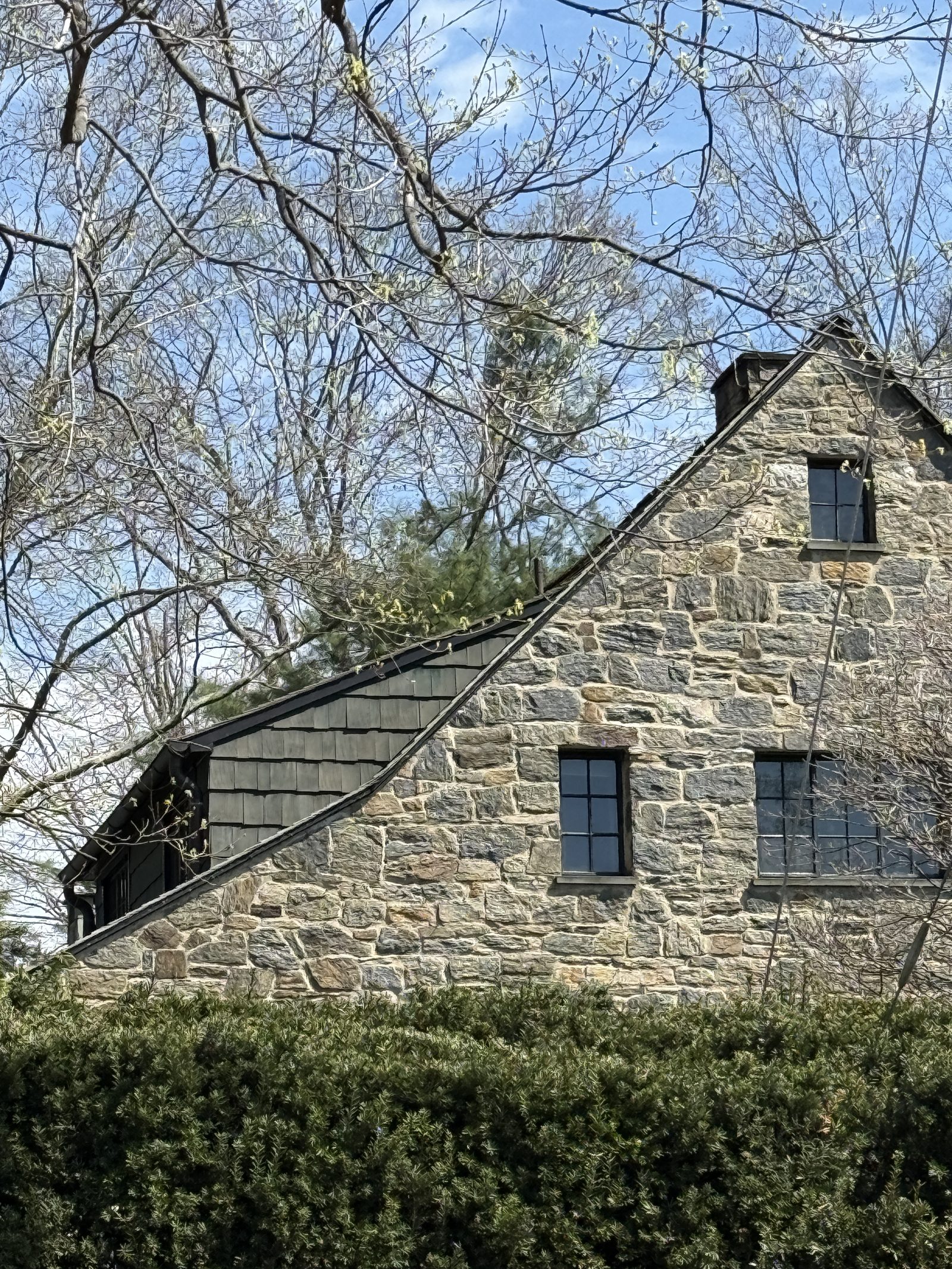
A ha-ha is a retaining wall built into a slope so that the top of the wall is at the level of the upper lawn and the face of the wall drops away to a lower paddock or field below. From the upper lawn, the landscape appears to extend without interruption to the horizon. The wall is invisible until you walk to the edge and look down — at which point you are standing at a 4-to-6-foot vertical drop with nothing between you and it. The name derives from the exclamation of surprise.
The ha-ha reads as a lawn edge from above and as a retaining wall from below. The upper face is turf, continuous with the lawn. The face of the wall — dry-stack stone or brick — drops vertically to the lower level. There is no railing, no fence, no visual interruption from the lawn side. This is the point: the boundary between the formal landscape and the agricultural landscape beyond is maintained without visible fencing.
A ha-ha is a below-grade retaining wall at the edge of a formal lawn or terrace, built of dry-stack stone, brick, or mortared fieldstone, with the wall top at lawn grade and the wall face dropping 3 to 6 feet to the level below. The typical ha-ha retains a slope — the garden is elevated relative to the surrounding land — and the wall provides both the retaining function and the invisible fence function. It originated in 18th-century English landscape design and was used on New England estates from the late 18th century onward.
A ha-ha in dry-stack fieldstone behaves like any dry-stack retaining wall — it drains freely and accommodates frost movement. The upper surface must drain away from the wall top to prevent water from saturating the retained soil. The lower face requires clear space for maintenance access.
The ha-ha is correct on estate properties in New England where the formal landscape transitions to agricultural land or naturalistic ground, and where maintaining a visual connection to the larger landscape without physical fencing is the design intent. It is not appropriate on suburban residential properties where the scale and the program are wrong.
A ha-ha is a civil and landscape engineering project as much as a masonry project. The retaining wall design must accommodate the soil pressure of the retained slope. Engage a landscape architect and a structural engineer before specifying.
Dry-stack fieldstone or mortared fieldstone ha-ha wall, 3 to 6 feet in height, wall top at upper lawn grade, for estate properties in New England where the formal landscape transitions to agricultural or naturalistic ground. Structural engineering required for walls over 3 feet. This is a landscape feature with a specific program and a specific history.
Something missing from the archive?
Suggest a material →