
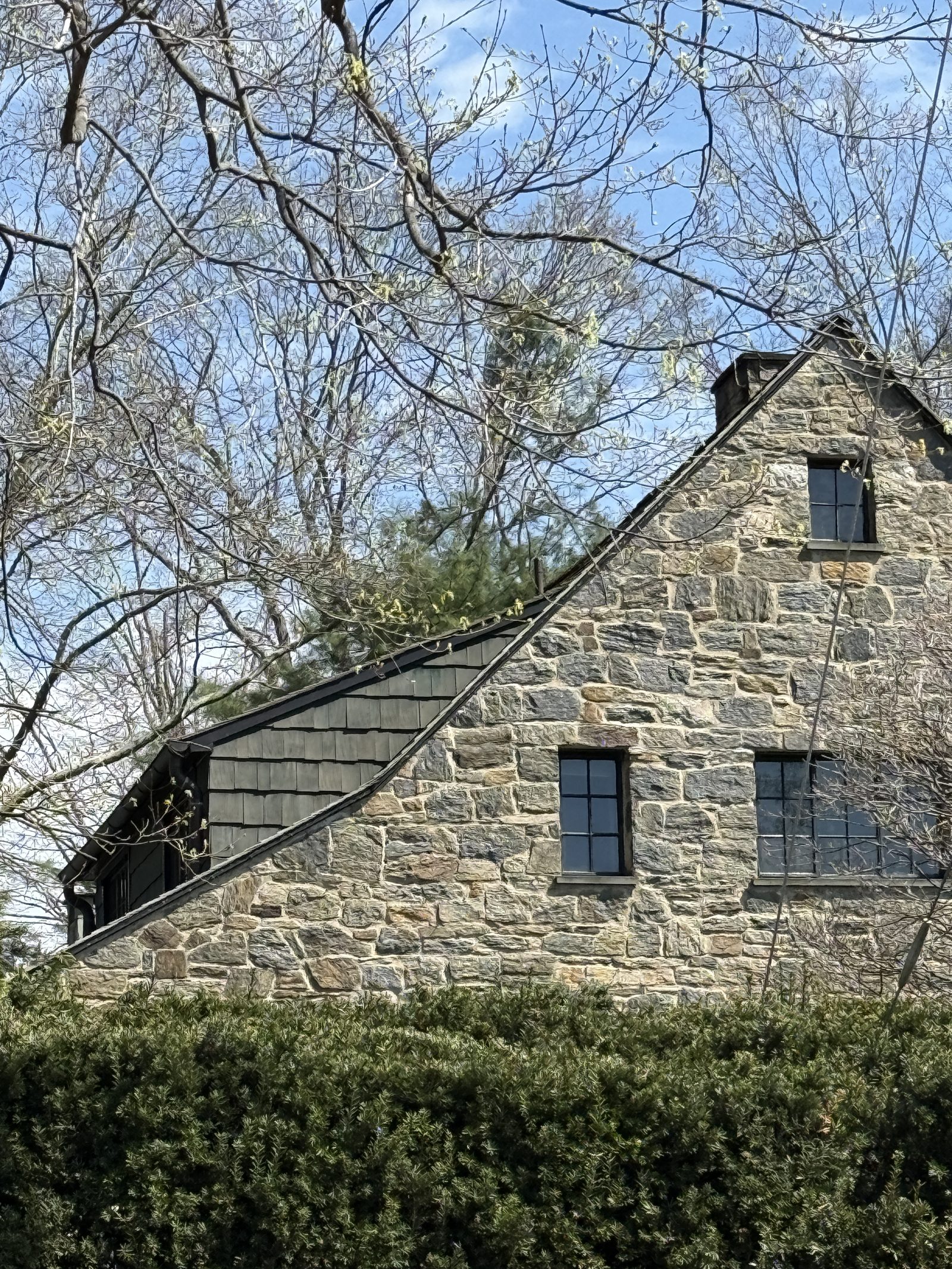
The walls were here before the houses. Before the roads, before the property lines, before anyone thought to document who built them or when. They run through the woods of Connecticut and Massachusetts and Vermont, through land that has not been farmed in a hundred years, tracing the boundaries of fields that are now forest. They are made of whatever the glacier left behind when it retreated, rounded granite and gneiss and schist pulled from the earth by generations of farmers clearing land one stone at a time. They have been sitting in place for two and three hundred years and they do not appear to be going anywhere.
This is fieldstone. The oldest building material in New England. The land itself, stacked.
There is no material in the New England landscape that carries more weight, literally or otherwise. A fieldstone wall reads as permanent in a way that a fence never does, that a hedge never quite does. It belongs to the land rather than sitting on it.
Up close it is endlessly varied. No two stones the same shape, the same color, the same surface texture. Granite goes silver in rain and pale gold in afternoon sun. Schist catches light along its cleavage planes and throws it back in flashes. Gneiss banded in grey and white reads like a slow geological argument. The mortar, where there is mortar, should recede. In dry-laid walls there is no mortar at all, only gravity and the mason's judgment about which stone sits on which.
Old fieldstone, lichen-covered and settled, is one of the few building materials that looks better at a hundred years than it did at one.
Fieldstone is not a single stone. It is a category defined by origin rather than geology. True fieldstone is stone gathered from the surface of agricultural land, rounded and weathered by glacial transport and centuries of exposure. It is distinguished from quarried stone by its irregular shape, its varied size, and the patina it carries from years in the earth.
In New England the dominant fieldstone types are granite, gneiss, schist, and quartzite, with occasional limestone in areas where the geology shifts. The color range runs from pale grey through warm buff to deep charcoal, with the warm tones generally predominating in Connecticut and southern New England and the cooler grey tones more common further north.
Reclaimed fieldstone, pulled from old walls being dismantled for development, is the best material available. It carries lichen and age and the particular irregular shape that comes from having been placed and replaced by hand over generations. New fieldstone pulled directly from the earth is a legitimate second choice but lacks the patina that reclaimed stone has accumulated.
Fieldstone is inert in the best possible sense. It does not rot, does not rust, does not require maintenance. A dry-laid fieldstone wall built correctly will outlast every other element of the landscape. The stones shift slightly over decades as the ground beneath them freezes and thaws, but this movement is self-correcting. A stone that heaves up in a frost cycle settles back in spring.
Wet fieldstone is darker and richer than dry. The lichen, if present, goes from pale grey-green to a vivid saturated green after rain. This transformation, stone and lichen wet after a summer storm, is one of the more extraordinary things the New England landscape produces and it costs nothing.
Dry-laid walls breathe. They allow water to pass through rather than accumulate behind them. In a region with the drainage challenges of New England this is not incidental. It is why dry-laid walls stand for centuries while mortared walls crack.
The alternatives to fieldstone walls in the New England landscape are instructive precisely because they are all inadequate. Pressure-treated fence posts read as temporary even when they are not. Split rail is rural in a way that is too specific, too decorative. Manufactured stone veneer, the most common contemporary substitute, achieves the look of fieldstone at a glance and fails it at five feet. The color is too uniform, the texture too consistent, the joints too regular. It reads as a product because it is one.
Real fieldstone does not read as a product. It reads as a consequence, something that happened to this piece of land over a very long time.
For foundations and chimneys fieldstone carries a different kind of authority. A fieldstone foundation on an old New England house anchors the structure to the land in a way that poured concrete never does. The house appears to grow from the ground rather than sit on it. This is not a small thing.
Source reclaimed fieldstone first. Salvage yards in Connecticut, Massachusetts, and Vermont regularly carry stone from dismantled walls and foundations. The stone will be irregular in size and varied in color, which is correct. Avoid lots that have been pressure-washed or treated. The patina is the point.
For new construction where reclaimed stone is unavailable, specify local stone wherever possible. Stone quarried or gathered within the region will match the geological palette of the surrounding landscape. Imported fieldstone, particularly the uniform brown fieldstone commonly available from large retailers, reads as out of place in a New England setting because it is.
For walls: engage a mason with experience in dry-laid construction. This is a skill that is less common than it should be and worth seeking out. The difference between a dry-laid wall built by someone who understands the material and one built by someone who does not is immediately visible and permanent.
For foundations and chimneys: mortared construction is appropriate and traditional. Specify a mortar color that recedes rather than advances. Grey or tan, never white. White mortar draws the eye to the joints and away from the stone, which reverses the intended hierarchy.
Reclaimed New England fieldstone, sourced from dismantled walls or foundations, for walls, foundations, and landscape applications. Varied size and color, lichen patina retained where present. Dry-laid construction for freestanding walls at grade. Mortared construction for foundations and chimneys with grey or tan mortar, tight joints, mortar set back slightly from the face of the stone. No manufactured stone veneer. No imported fieldstone where local material is available. The wall that looks as if it has always been there has, in most cases, always been there. That is the standard.
Something missing from the archive?
Suggest a material →