
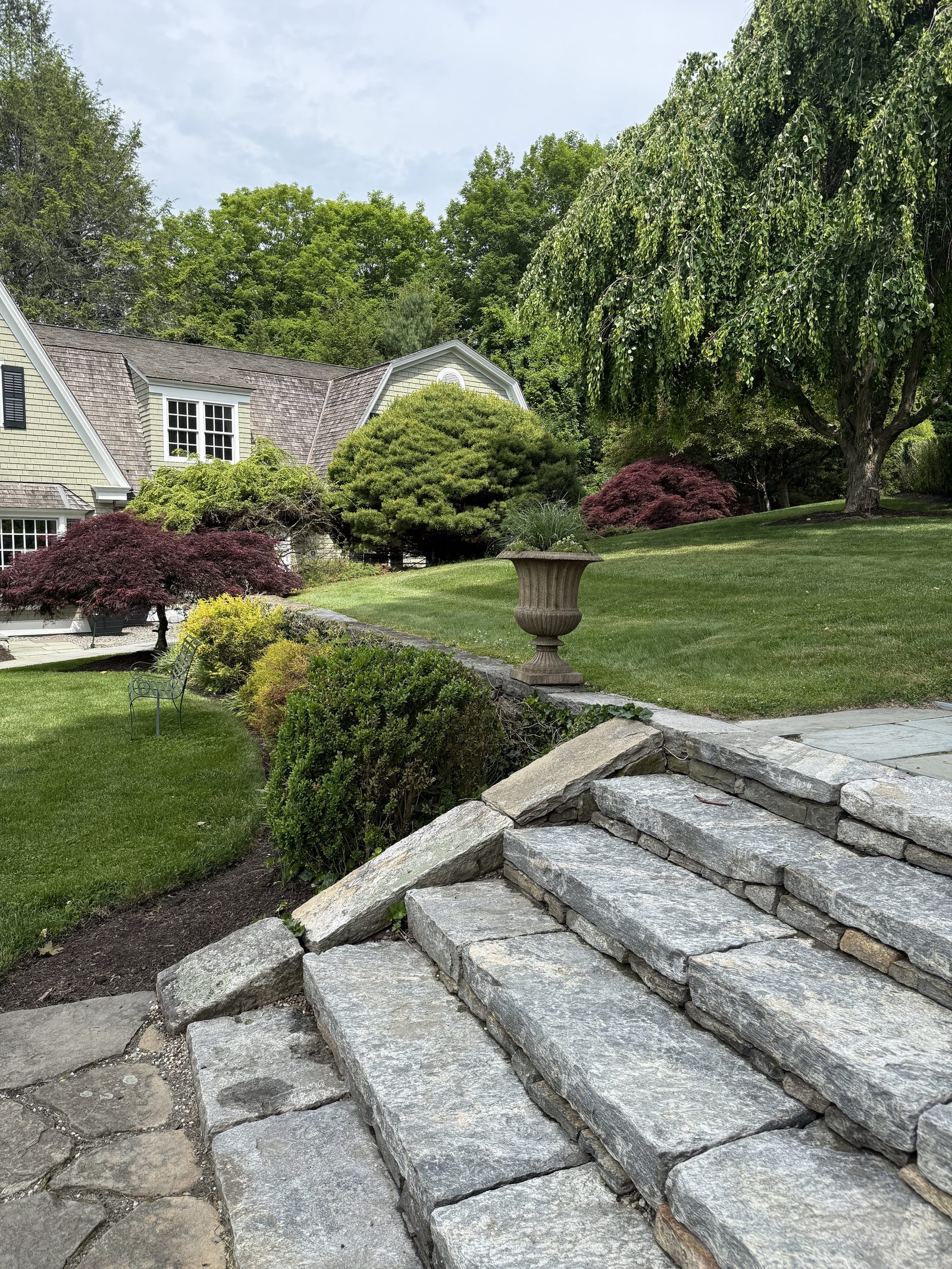
Granite is everywhere in the New England landscape and most people do not notice it specifically because it is so completely of the place. The curbing along the edges of old roads. The steps up to a front door that has been approached ten thousand times. The posts at the end of a driveway that have marked the entry to a property for a hundred and fifty years. These things are granite, and they are granite because granite is what the glaciers left behind and what the quarries of Vermont, New Hampshire, and Maine have been pulling from the ground since before the Revolution.
Granite in the New England landscape reads as part of the land because it is part of the land. The grey of old granite curbing, worn smooth at the top edge by a century of wheels and feet, is a color that belongs here in the way that imported limestone or precast concrete does not. It is the same grey as the fieldstone walls, the same grey as the November sky, the same grey as weathered cedar in its fifth year.
Wet granite deepens to a darker, richer tone. The crystalline structure of the stone catches light differently than any cut or manufactured material. In morning light a granite step has a quality that cannot be described as anything but beautiful, and it requires no maintenance to achieve it.
New England granite comes primarily from quarries in Vermont, New Hampshire, Maine, and Connecticut. The dominant colors are grey, blue-grey, and buff-grey, with regional variation depending on the specific quarry. Barre, Vermont granite is a fine-grained blue-grey that has been the standard for architectural and monument granite in New England for over a century. Westerly, Rhode Island granite is a warm grey with pink undertones. Each has its place and its character.
For traditional landscape applications, reclaimed granite is almost always the better choice over new quarried stone. Old granite curbing pulled from road projects carries the wear, the color development, and the surface character that new granite lacks. It also carries the material history of the region in a way that is not trivial.
Granite for landscape use comes in three main forms. Curbing is long rectangular pieces, typically 5 to 6 inches wide and 16 to 24 inches long, used to edge driveways, walks, and planting beds. Steps are dimensional pieces cut to specific riser and tread dimensions. Posts are vertical pieces, typically square in section, used as gate posts, lamp posts, and driveway markers.
Granite is effectively permanent in landscape applications. It does not rot, does not rust, is not affected by freeze-thaw cycles in any meaningful way, and requires no maintenance. A granite step set correctly in a compacted base will still be in place and still be level in fifty years. The same step set in inadequate base material will shift, heave, and require releveling within a decade.
The surface of granite changes slightly with age. New quarried granite has a relatively bright, sharp surface. Over years of weathering, foot traffic, and exposure, the surface develops a slight softening, a rounding of edges, a deepening of the grey that registers as age even if you cannot name it. This change is correct. It is the material settling into the landscape.
The alternatives to granite in traditional New England landscape applications fail in characteristic ways. Precast concrete curbing is uniform in a way that reads as industrial. Brick edging is fragile under wheel loads and in freeze-thaw conditions. Pressure-treated lumber edging weathers and fails. None of them have the presence, the permanence, or the regional authenticity of granite.
For steps, the alternatives are even weaker. Poured concrete steps are the most common substitute and the most wrong. They read as utilitarian regardless of what is done to finish them. Granite steps, even new ones, read as having been there for a long time. Old ones are impossible to distinguish from the original fabric of the property.
For curbing: source reclaimed granite from salvage yards, road project surplus, or stone suppliers who stock antique material. Specify pieces that are consistent in height, 5 to 6 inches, and in reasonable condition with no major fractures. The irregular lengths and slight variations in width are correct. Uniformity is not the goal.
For steps: new granite cut to dimension is appropriate and available. Specify a thermal or natural cleft top surface for traction, not a polished surface which becomes dangerously slippery when wet. Tread depth of 14 to 16 inches and riser height of 6 to 7 inches are traditional proportions that feel right underfoot.
For posts: reclaimed granite fence posts are available from salvage sources and are the correct choice. New posts cut to dimension are acceptable. Standard dimensions are 4x4 or 5x5 inches in section, height depending on application.
Reclaimed New England granite for curbing and posts — irregular lengths, 5 to 6 inches in height, natural surface character retained. New granite for steps — thermal or natural cleft top surface, 14 to 16 inch tread, 6 to 7 inch riser. Set in compacted gravel base with concrete haunching at curbing. No precast concrete substitutes. No polished surfaces in exterior applications. Granite is the material of this landscape. It requires no improvement and no approximation.
Something missing from the archive?
Suggest a material →