
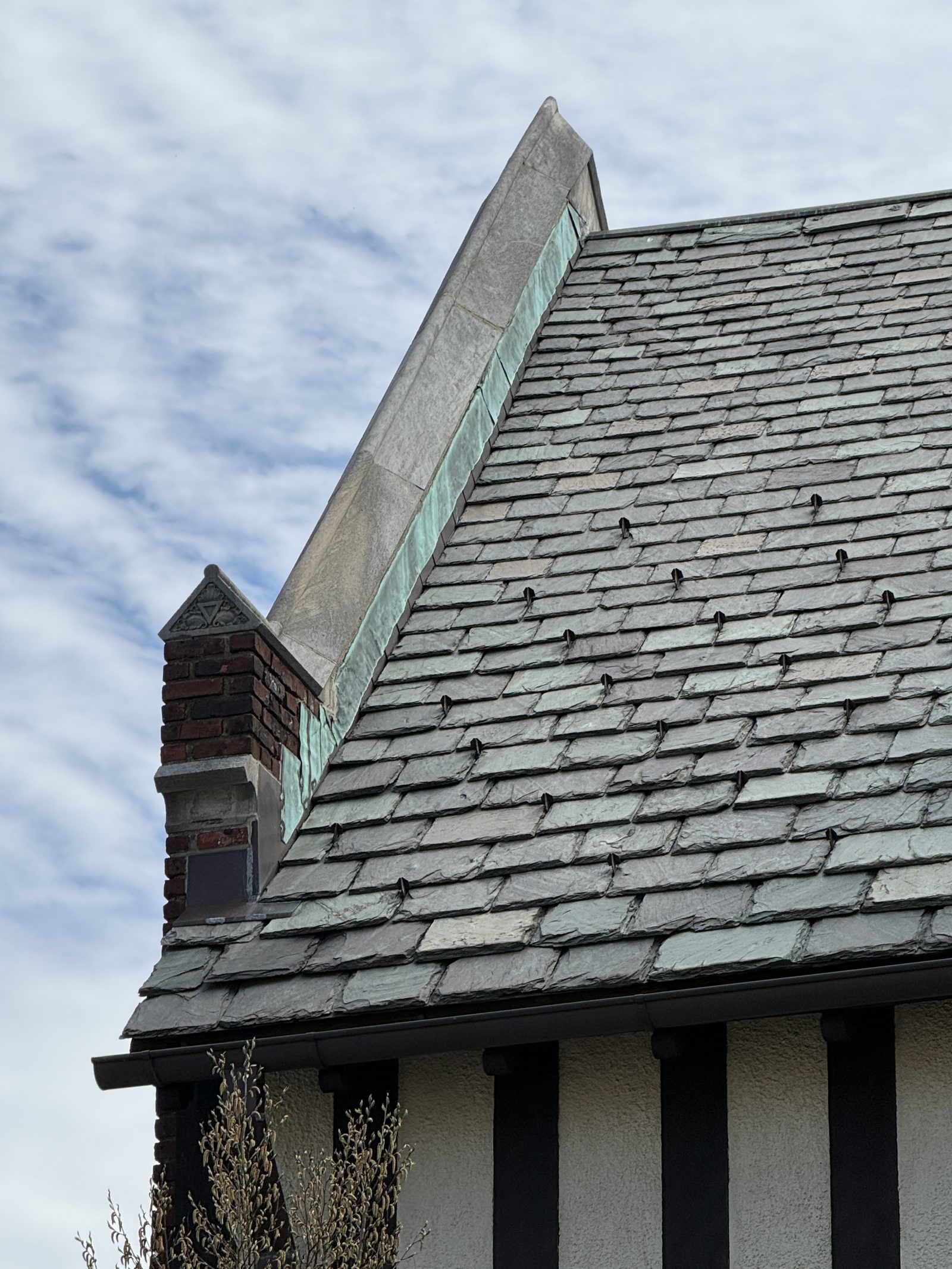
A steep metal or slate roof sheds snow efficiently, which is exactly the problem. Without intervention, accumulated snow releases suddenly in large, heavy sheets directly off the eave, onto whatever is below — a walkway, a parked car, a person. Snow guards and rails manage this release, breaking the load into smaller, safer increments or holding it in place until it melts.
Individual snow guards are small, discreet elements — cast or formed pieces, often in a pattern across the lower roof slope, that interrupt the sliding snow layer without being visually prominent from the ground. Snow rails are a more continuous horizontal bar system, more visible but providing a more robust barrier for heavier snow loads.
For standing seam metal roofs, snow guards are typically clamped to the seams without roof penetration, in a pattern determined by roof pitch, snow load, and panel spacing — usually two to three rows near the eave on a steep roof. For slate roofs, individual cast bronze or copper snow guards are set into the slate courses near the eave, fastened through pre-drilled holes with appropriate flashing.
Correctly specified and installed snow guards distribute the load of sliding snow across many small points rather than concentrating it at the eave edge, preventing the sudden, dangerous slide common on unprotected steep metal or slate roofs. Underspecified systems — too few guards, or guards rated for a lower load than the roof actually experiences — can fail or simply be overwhelmed in a heavy snow year.
Any steep metal or slate roof in New England over a walkway, entry, deck, or parking area needs snow management at the eave. This is a safety specification, not an optional decorative addition, and should be engineered to the specific roof pitch and regional snow load, not simply added as an afterthought with a generic product.
Snow retention manufacturers (S-5! for clamped metal roof systems, and specialty slate roofing suppliers for cast slate guards) provide load calculations based on roof pitch, panel or slate type, and regional snow load data. Work with the roofing contractor to specify pattern and quantity engineered to the specific roof, not a standard retrofit kit.
Engineered snow guard or snow rail system, specified to the roof's pitch, material, and regional snow load — clamped (non-penetrating) systems for standing seam metal, cast bronze or copper guards set into slate courses near the eave — at all steep metal and slate roof sections over walkways, entries, and parking areas in New England. This is a safety specification, engineered per roof, not a generic retrofit.
Something missing from the archive?
Suggest a material →