
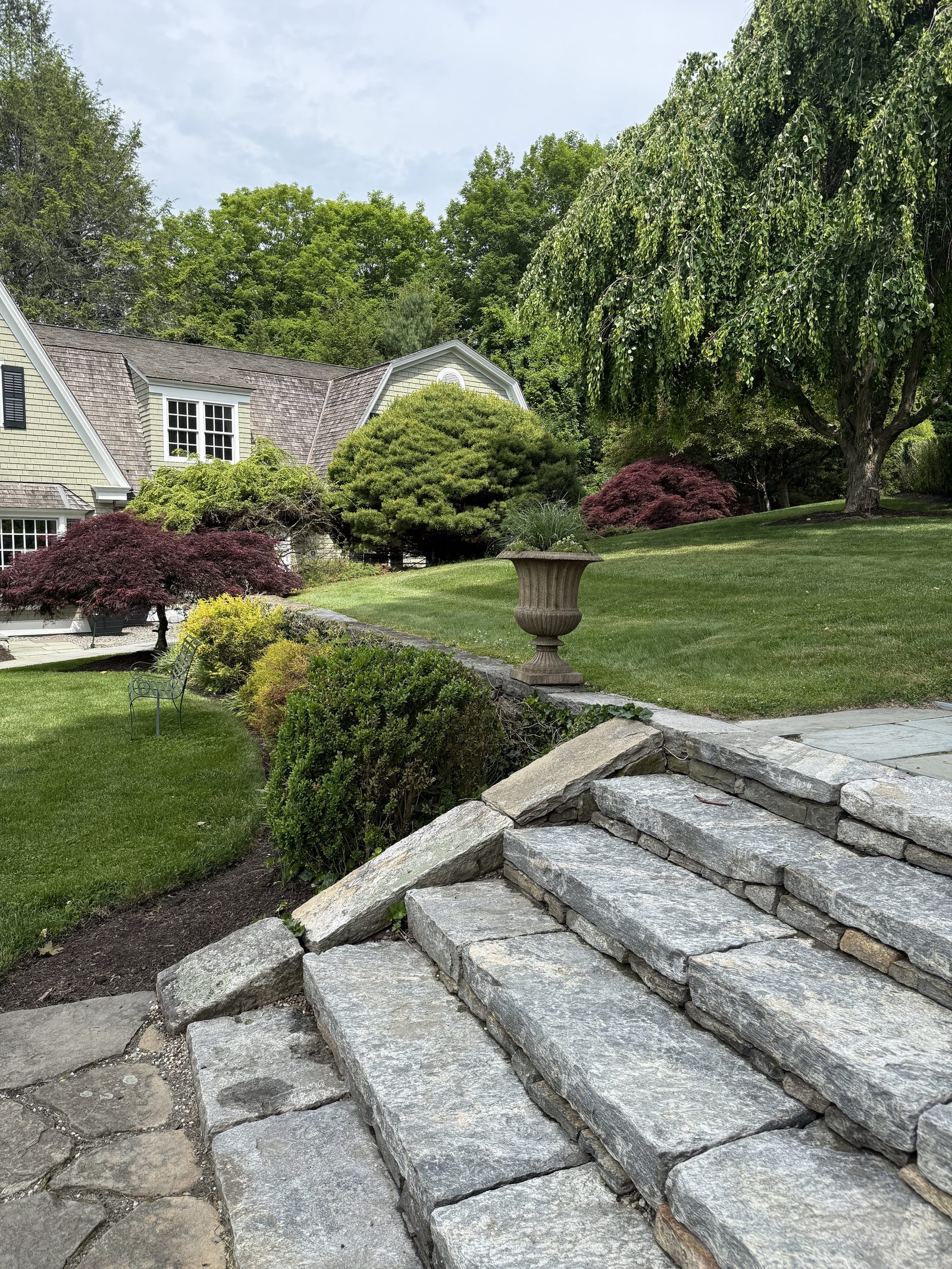
The cobblestone street and the Belgian block street look similar from a distance and are entirely different underfoot. Cobblestone is rounded — a water-worn or naturally rounded granite stone, set tightly in sand with no consistent face. Belgian block is sawn — a rectangular unit with flat faces and consistent dimensions. Both appear in historic New England streetscapes. They are not the same material, and they are not interchangeable.
Granite cobblestone is grey to blue-grey, rounded, irregular in size from approximately 4 to 8 inches in their longest dimension. Set in a street or courtyard, the surface is uneven — slightly rolling, with the rounded tops of each stone proud of the setting sand. It is not a comfortable walking surface. It was never meant to be. It was meant to be driven on by iron-wheeled vehicles, and it was far superior to dirt or gravel for that purpose.
Granite cobblestones are naturally rounded or hand-dressed granite stones, quarried and shaped in New England from the 18th century onward. They are dimensionally irregular. Set sizes are typically classified as "small" (3 to 5 inches), "medium" (4 to 6 inches), or "large" (5 to 8 inches). They are set in a sand-set or mortar-set installation with joints filled with stone dust or mortar. The material is almost entirely salvage at this point — original cobblestones pulled from street resurfacing projects are the primary source.
Granite cobblestone is nearly indestructible. The stones themselves do not deteriorate. What fails is the setting and the joint material. Sand-set cobblestone will shift over time and requires periodic resetting. Mortar-set cobblestone is more stable but loses the slight flex of sand setting. In a frost environment, sand setting is often more durable because it accommodates movement that would crack a rigid mortar bed.
Cobblestone is correct for carriage courts, stable yards, service entries, and historic streetscape restoration in New England. It is not a driveway material for contemporary use — the surface is too irregular for comfortable automobile travel at speed. Its place is specific: it signals an entry that was designed for horses and carriages, and that history is part of what makes it correct in those settings.
Salvage granite cobblestone is available from architectural salvage dealers, road reclamation contractors, and some stone yards in New England. Supply is inconsistent and price varies with availability. Specify "salvage granite cobblestone, medium grade, 4 to 6 inch" for courtyard and entry work.
Salvage granite cobblestone, medium grade, 4 to 6 inch, sand-set in a minimum 4-inch crushed stone base with stone dust joints, for carriage courts, stable entries, and historic streetscape restoration in New England. Not appropriate as a primary automobile driveway surface. Source early and confirm availability before committing to it in a design.
Something missing from the archive?
Suggest a material →