
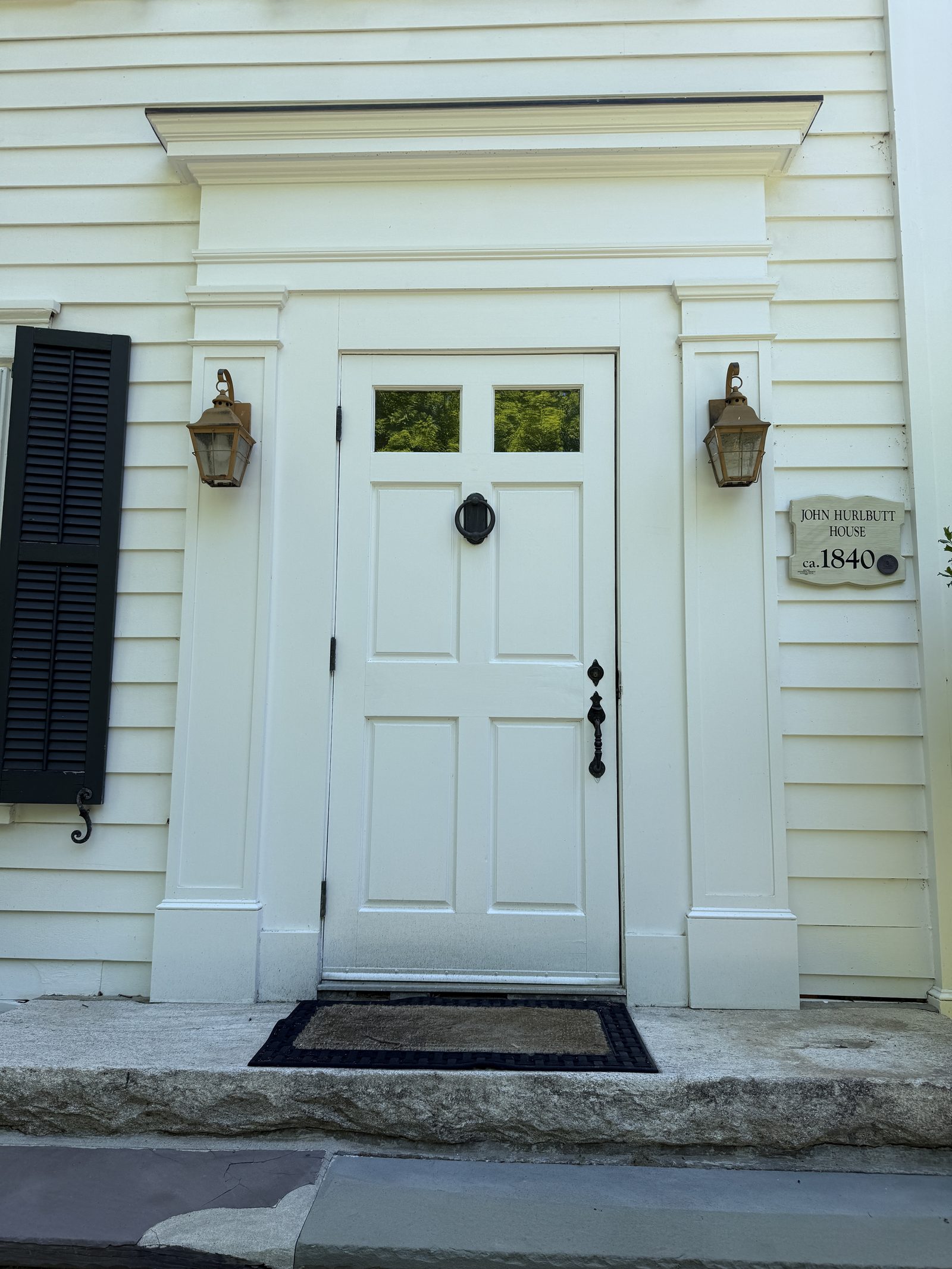
Granite curbing lines the streets of every old New England town. It defines the edge between road and sidewalk with a permanence that no concrete or asphalt alternative approaches. When municipalities replace it with poured concrete — which they do, for cost reasons — the salvage granite finds its way to stone yards and landscape contractors, where it belongs on driveway edges, terrace perimeters, and garden walls at traditional residential properties.
Granite curbing is a rectangular granite stone, typically 5 to 6 inches wide and 16 to 20 inches tall, with 6 to 10 inches exposed above grade and the rest buried as the foundation. The face is rock-split or sawn. The color is New England granite grey — blue-grey to silver, with the characteristic sparkle. Set at a driveway edge, it defines the boundary between the gravel surface and the lawn with the authority of something that was always there.
Standard New England granite curbing is 5" x 16" to 6" x 20" in cross-section, in lengths of 4 to 8 feet. It is set on a compacted gravel base with the face at or slightly above the adjacent paving surface. Salvage curbing from street replacement projects is the primary source and is often less expensive than new material while being identical in appearance and performance.
Granite curbing does not deteriorate. Individual pieces may shift with frost if the base is inadequate, but the stone itself is essentially permanent. Resetting shifted curbing is the primary maintenance task, on a cycle of decades.
Granite curbing at the driveway edge is the detail that separates a traditional New England property from a generic residential landscape. Steel edging is correct for garden beds. Granite curbing is correct where the edge carries real load — the edge of a driveway, the perimeter of a terrace, the border of a formal garden.
From stone yards that stock salvage curbing. Contact municipal public works departments in your area — they often sell salvage curbing directly when streets are reconstructed. Specify lengths and confirm the face finish is consistent within the order.
Salvage or new New England granite curbing, 5-inch minimum width, set on compacted crusher run base with 6 inches of exposure above adjacent grade, for driveway edges, terrace perimeters, and formal garden borders at traditional New England residential properties. This is the material that defines the edge permanently.
Something missing from the archive?
Suggest a material →