
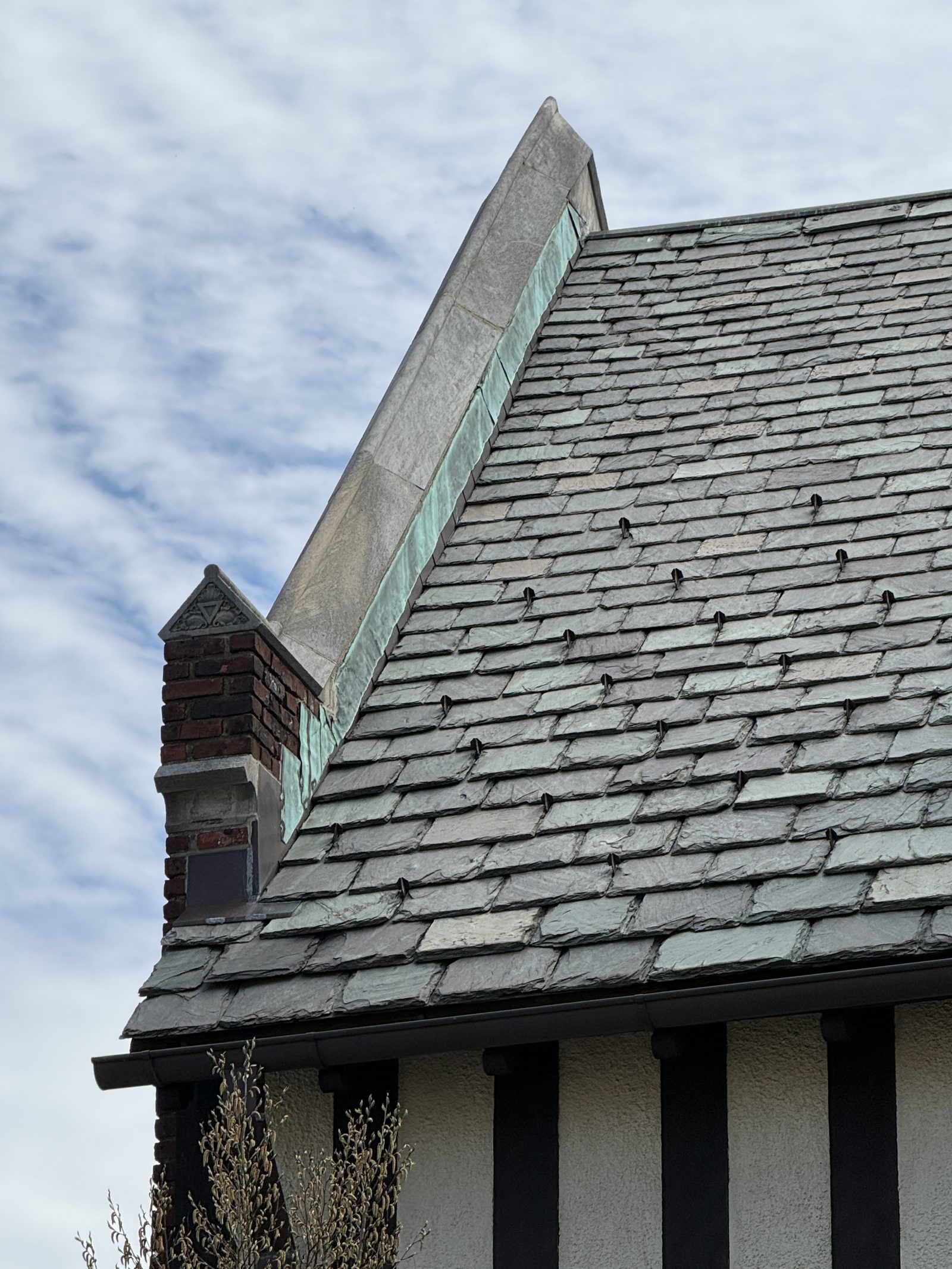
Roofing slate and flagging slate are quarried from the same stone and used for completely different purposes. Roofing slate is thin, split fine, and meant to shed water from above at a steep pitch. Flagging slate is thick, irregular, and meant to be walked on. Calling both simply "slate" obscures a specification difference that matters as soon as you try to order the material.
Flagging slate is thick — 3/4" to 1-1/2" — compared to the 3/16" of roofing slate. The surface is the natural cleft face, slightly textured, slip-resistant when wet in a way that a smooth sawn stone is not. The color range is the same as roofing slate from the same quarry: grey-green to purple to mottled, depending on Vermont or Pennsylvania origin.
Flagging slate is sold by the ton in irregular pieces, typically 1" to 2" thick, sorted into size ranges (small, medium, large format) for walkway and terrace use. It is also available cut to randomly rectangular dimensions for a more ordered pattern. Pennsylvania and Vermont quarries both produce flagging-grade slate as a byproduct of roofing slate production — the thicker, less uniform material that does not meet roofing tolerances is sold as flagging.
Flagging slate is durable and slip-resistant in its natural cleft state. It should never be honed or polished for exterior use — a smooth slate surface is dangerous wet. Set on a compacted base with adequate drainage, it performs indefinitely in New England frost conditions.
Flagging slate is correct for garden paths, terraces, and entry walks on traditional New England properties where a slate-association is desired but bluestone is not the specific intent. It reads differently than bluestone — more textured, more irregular, often darker.
From the same Vermont and Pennsylvania quarries and dealers that supply roofing slate. Specify "flagging slate" explicitly — ordering "slate" without qualification risks confusion with roofing material. Sort by thickness and size range for the specific application.
Natural cleft slate flagging, 1 to 1-1/2 inch thickness, irregular or randomly rectangular pattern, set over 4-inch compacted crushed stone base, for walks and terraces on traditional New England properties. Never honed for exterior use. Specify flagging grade explicitly when ordering — distinct from roofing slate.
Something missing from the archive?
Suggest a material →