
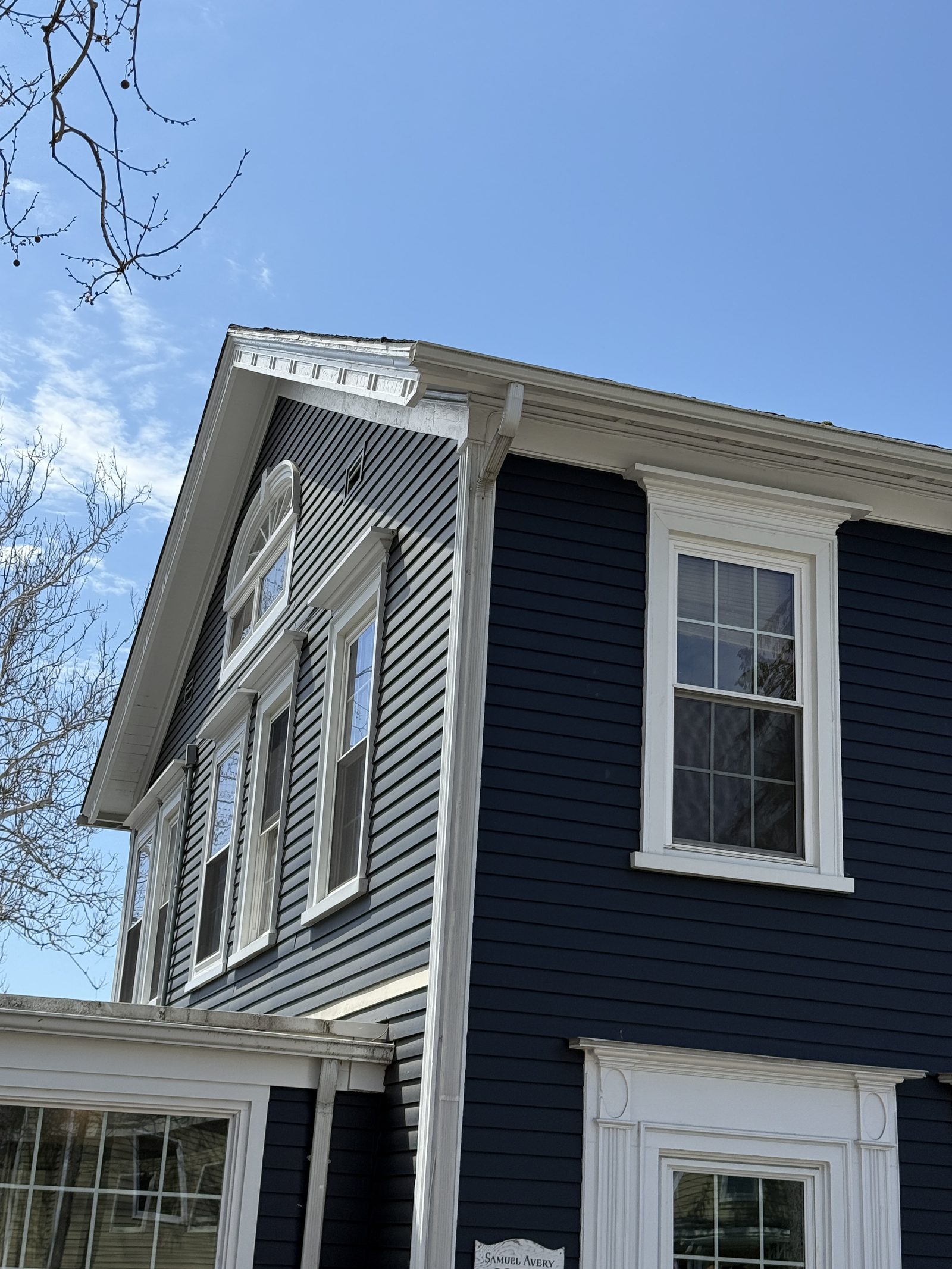
Trim is the face of the building. The corner boards, the window casings, the frieze, the rake, the water table — these are the elements that define whether a building looks like itself or like an approximation of itself. The profiles matter. The material matters. The thickness matters. A building with thin, flat trim boards reads differently from one with 5/4 stock correctly profiled, and the difference is visible from across the street.
Painted white or off-white in most traditional New England applications. The trim stands slightly proud of the clapboard or shingle siding behind it. Its edge profiles — the ogee on a window casing, the crown on a cornice, the quarter-round on a water table — cast shadows that define the building's facade. The depth of those shadows depends on the thickness of the trim and the complexity of the profile. Flat trim casts no shadow. It reads as applied ornament rather than built architecture.
Exterior trim boards in the New England tradition are milled from clear white pine (Pinus strobus) in 5/4 thickness (actual 1-1/16") for flat boards and casings. Standard profiles for traditional buildings: flat casing with back band, 3-1/2" to 4-1/2" face width; corner boards 3-1/2" to 5-1/2" face, square or with a small bead; frieze board flat or with a small ogee at the top; rake board follows the roof pitch with a bed mold below. All profiles derived from classical orders at a domestic scale.
White pine trim, properly primed and painted, performs well in New England exterior conditions. It must be back-primed — sealed on all faces including the back and end grain — before installation. It expands and contracts with moisture and must be nailed with appropriate allowance for movement. Paint failures on exterior trim almost always trace back to unpainted back faces or unprimed end grain allowing moisture in.
5/4 clear white pine trim with appropriate profiles is the historically correct specification for New England buildings from the Colonial period through the early 20th century. 3/4" flat trim — which is what most builders use today — produces a thin, shadowless facade. The extra thickness, correctly profiled, is what makes the difference between a building that looks built and one that looks assembled.
Order 5/4 clear white pine from a lumber yard that stocks it — not all do. For complex profiles, work with a local millwork shop that can produce custom profiles from clear stock. Standard profiles (ogee, beaded edge, back band) are often available as stock moldings. Prime all trim on all faces before it leaves the shop or yard.
Clear eastern white pine, 5/4 stock, for all exterior trim boards on traditional New England residential buildings. Back-prime all faces before installation. Window casings minimum 3-1/2" face width with back band or edge profile. Corner boards minimum 3-1/2" face, square with small bead. Do not use 3/4" stock for exterior trim on a traditional building. The shadow the profile casts is the point.
Something missing from the archive?
Suggest a material →