
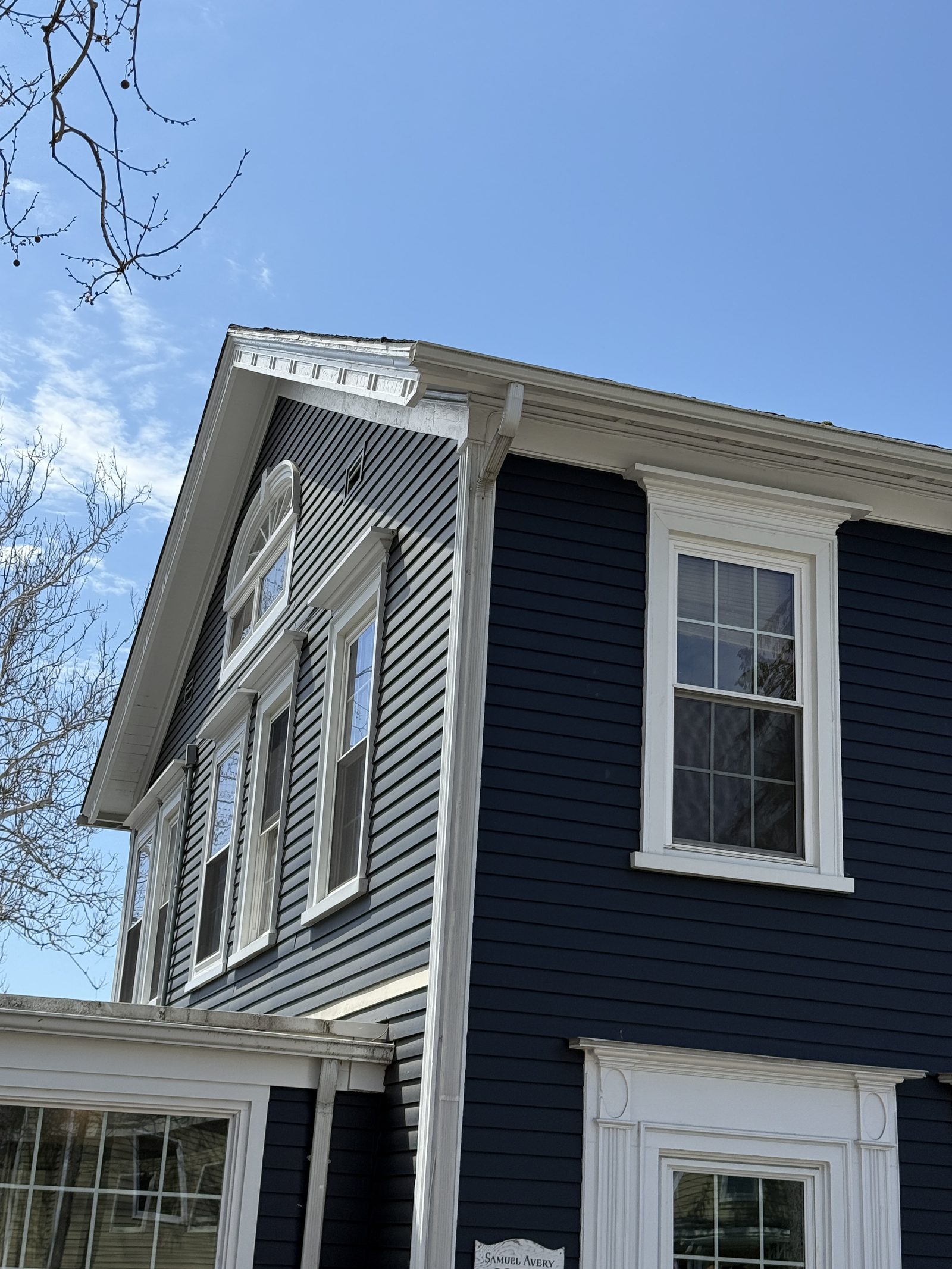
The painted clapboard house is the primary image of New England architecture. White clapboard against dark shutters, against green trees, against a grey sky. It is so familiar that it can seem to require no specification at all, as if the right thing will simply emerge from the material. It does not. The difference between a clapboard exterior that looks right and one that looks like a renovation is entirely in the profile, the exposure, the corner details, and the relationship between the siding and the trim.
A clapboard wall on a traditional New England house reads as a single unified surface from any distance. The shadow lines from the lapped boards are regular, consistent, and quiet. The corners are sharp. The trim boards at windows, doors, corners, and eaves are proportioned to the siding, not to a modern standard. The whole exterior has a coherence that comes from understanding how each element relates to the others.
Up close the painted wood surface has a quality that no synthetic material yet approximates. The paint sits in the wood rather than on it. The grain shows through in certain lights. After a few seasons the paint develops a patina that distinguishes it from a freshly painted surface in the way that a well-worn leather seat is distinguished from a new one.
Traditional clapboard is eastern white cedar or clear white pine, bevel-cut so the board is thicker at the bottom edge than the top. The taper creates the shadow line that gives a clapboard wall its texture and depth. Fiber cement clapboard products exist and are increasingly common. They are dimensionally stable, hold paint well, and require less maintenance than wood. They are not the same material and they do not read the same way.
Profile matters. Traditional clapboard profiles have a steeper taper than modern bevel siding. The thick bottom edge, typically 7/16 to 1/2 inch, creates a more pronounced shadow line and a heavier visual weight that is appropriate to historic architecture. Thin-profile modern siding reads as flat even when it is technically lapped because the shadow line is too slight to register.
Wood clapboard moves with moisture and temperature. It expands in wet weather and contracts in dry. This movement is the reason proper priming is not optional. All six faces of every board, including the cut ends, must be primed before installation. End grain that is left unprimed will absorb moisture, swell, and eventually cause paint failure from the inside out. This is the most common mistake in clapboard installation and the most expensive to correct.
Exposure, the amount of each board left visible below the one above it, determines the visual rhythm of the wall. Traditional exposure is between 4 and 5 inches on a standard 6-inch clapboard. Wider exposures read as modern. Narrower exposures, which require more boards and more labor, are historically appropriate on formal Federal and Greek Revival houses where the finer coursing is part of the architectural language.
The alternatives to wood clapboard on a traditional New England house are a matter of honest assessment. Fiber cement is a legitimate material that performs well and is appropriate on new construction where the budget does not support wood. It is not appropriate on historic houses where the authenticity of the material matters, and it does not age in the way wood ages. It stays the same.
Vinyl siding is not appropriate on a traditional property under any circumstances. The profile is wrong, the surface is wrong, the way it moves and reflects light is wrong. It reads as a shortcut because it is one.
Specify eastern white cedar or clear white pine clapboard with a traditional bevel profile, 6-inch face width, 7/16 to 1/2 inch thick at the butt. Prime all six faces before installation including cut ends. Install at 4 to 4.5 inch exposure for standard residential work, adjusting to match existing coursing on historic properties.
Corner boards should be thicker than the clapboard butt edge, typically 1x4 or 1x6 depending on the scale of the house. The clapboard butts against the corner board rather than mitering at the corner. This is the traditional detail and it is also the more durable one.
Paint system matters as much as the wood. An oil-based primer on raw wood, followed by two coats of high-quality exterior latex, is the standard for new installation. Linseed oil primer, discussed separately in the paints and finishes section, is the historically correct system and the one that performs best over time on old houses.
Eastern white cedar or clear white pine clapboard, traditional bevel profile, 6-inch face, 7/16 to 1/2 inch butt. All faces primed before installation including cut ends. Exposure of 4 to 4.5 inches. Corner boards of 1x4 or 1x6, clapboard butting against rather than mitering. Oil-based or linseed oil primer, two coats exterior finish. The profile, the exposure, and the priming are not details. They are the material.
Something missing from the archive?
Suggest a material →