
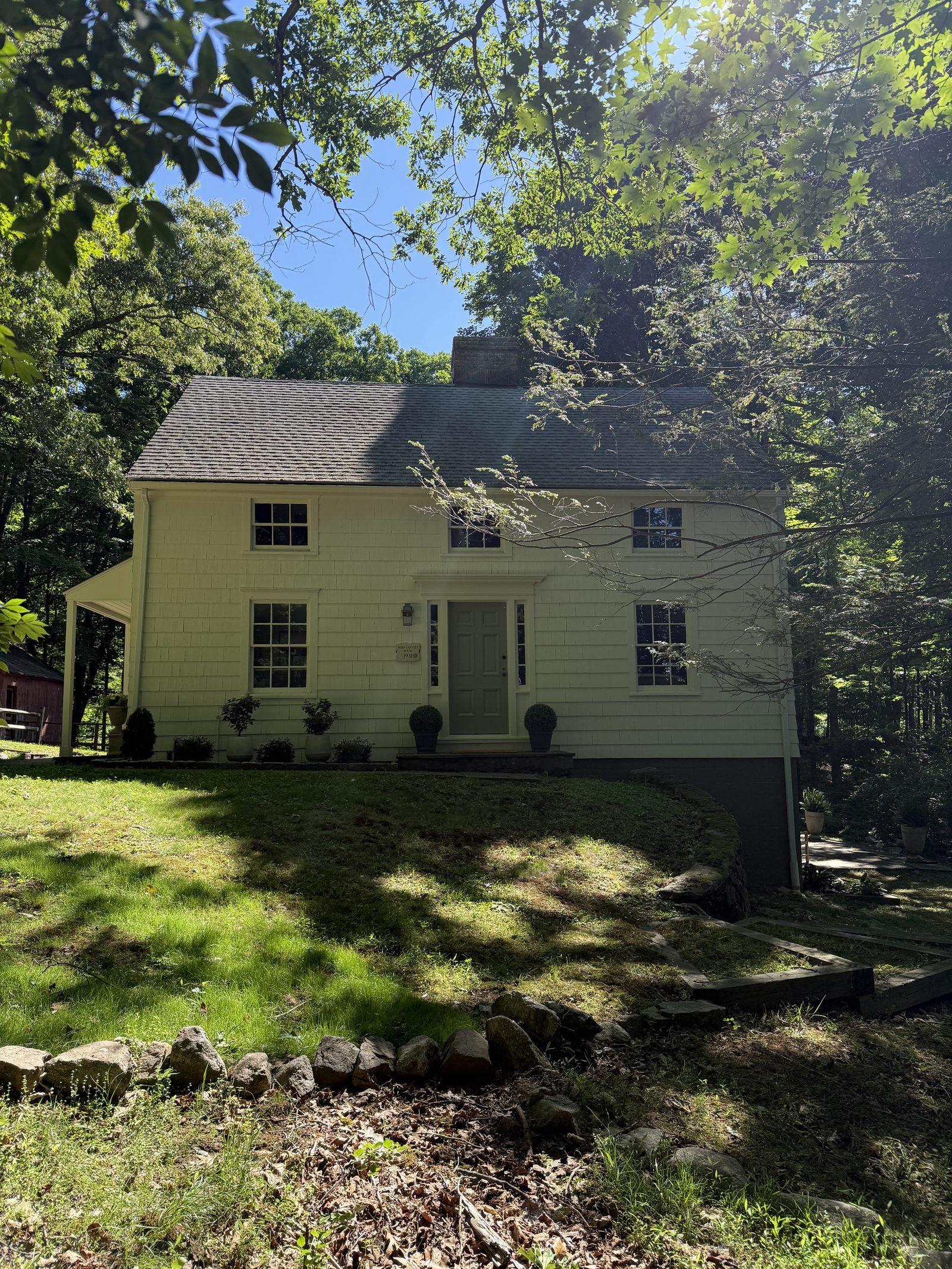
Every painted house in New England was originally painted with linseed oil paint. This is not a historical curiosity. It is a fact with practical implications for anyone restoring or maintaining a traditional house, because linseed oil paint and modern latex paint behave differently, fail differently, and require different approaches to surface preparation. Putting latex paint over a surface that was originally linseed oil, without understanding what is underneath, is one of the most common sources of paint failure on old houses.
Linseed oil paint looks different from latex paint. The difference is subtle and immediately legible to anyone who has spent time around old houses. Linseed oil paint has a slight warmth in whites and off-whites, a quality that comes from the oil itself. It has a sheen that is neither flat nor glossy but something in between, the sheen of a well-oiled surface rather than a coated one. It does not look plastic.
As it ages, linseed oil paint weathers slowly and evenly. It chalks at the surface, which is the correct failure mode — the surface erodes gradually and the paint beneath remains sound. Latex paint, by contrast, forms a film that can peel, crack, and fail at the interface between paint and wood rather than at the surface. On an old house with many layers of paint history, the failure modes of these two systems are entirely different.
Linseed oil paint is made from boiled or raw linseed oil, pigment, and a drier. The oil penetrates the wood fibers rather than forming a surface film. It cures through oxidation rather than evaporation, which is why it dries slowly — typically 24 hours between coats in warm weather, longer in cool or humid conditions. This slow cure is also why it performs differently than latex in all weather conditions.
Traditional formulations used white lead as the primary pigment. Lead paint is no longer available for residential use, and modern linseed oil paints use titanium dioxide as the white pigment. The performance is not identical to historic lead paint but it is significantly closer to the historic material than any latex product.
Scandinavian manufacturers, particularly Ottosson and Allback, produce high-quality linseed oil paints that are increasingly available in the United States and are used by historic preservation specialists for restoration work. These are the products that come closest to the historic standard.
Linseed oil paint applied to bare wood penetrates deeply and creates a bond with the wood fiber rather than a coating on top of it. This penetration is why old houses with many intact layers of linseed oil paint can be stripped with difficulty — the paint has become part of the wood surface rather than a separate layer on top of it.
In service, linseed oil paint allows the wood beneath it to breathe. Moisture can move in and out of the wood without building up pressure behind the paint film. This is why linseed oil paint on old wood does not blister the way latex paint does. Latex forms an impermeable film. When moisture in the wood tries to escape, it has nowhere to go and blisters the paint from behind.
Linseed oil paint requires more coats than latex for initial coverage, and it requires longer drying time between coats. A proper linseed oil paint system on new wood is three coats minimum, with the first coat thinned with additional linseed oil to maximize penetration. The total labor investment is higher than latex. The result, and the longevity, justify it on any house where the exterior is a significant element.
On a historic New England house, linseed oil paint is not the traditional finish because it is traditional. It is the traditional finish because it is the correct finish for the material it was designed to protect. Old-growth wood, which is what most pre-twentieth-century houses are built from, is a different material than modern kiln-dried lumber. It is denser, more stable, and more resinous. Linseed oil paint was developed in concert with this material over centuries. They work together.
Latex paint on old wood is a mismatch of systems. It works adequately in many situations but fails characteristically in others, and the failures are difficult and expensive to correct because they require removing not just the failed latex but all the linseed oil layers beneath it before a new latex system can be applied successfully.
For restoration of historic houses: source linseed oil paint from Ottosson, Allback, or similar Scandinavian manufacturers. Apply a thinned first coat to bare wood, full-strength second coat, full-strength finish coat. Colors should be mixed to match historic samples where they exist. The whites and off-whites of linseed oil paint have a warmth that is not achievable with titanium dioxide latex and should not be approximated with a cooler white.
For new construction on traditional properties: linseed oil primer on bare wood followed by two coats of high-quality exterior latex is a legitimate compromise between historic practice and modern convenience. The primer provides the critical penetration and wood bonding that latex alone cannot achieve. This system performs better than latex alone and is significantly less labor-intensive than a full linseed oil paint system.
For historic restoration: Ottosson or Allback linseed oil paint, thinned first coat to bare wood, two full-strength finish coats. Colors mixed to match historic samples. For traditional new construction: linseed oil primer on all bare wood surfaces followed by two coats high-quality exterior latex. The primer is not optional. Linseed oil paint ages into the wood. Latex paint sits on top of it. The difference is visible and the consequences of confusing them are expensive.
Something missing from the archive?
Suggest a material →