Eastern white pine built New England. It framed the houses, lined the floors, paneled the walls, and trimmed the windows of every vernacular building in the region for two hundred years. It is not a compromise material. It is the material the region produced in extraordinary quantities, that its builders understood completely, and that its buildings still demonstrate was the correct choice.
Pale straw to warm cream when fresh-cut. The grain is straight and fine, with subtle growth ring patterns visible on flat-sawn boards. It is soft underfoot and soft to the touch. Painted, it holds paint as well as any wood. Left raw and exterior, it silvers slowly. The knots in lower-grade white pine are warm amber to dark brown, and in traditional New England construction they are not a defect. They are part of the character.
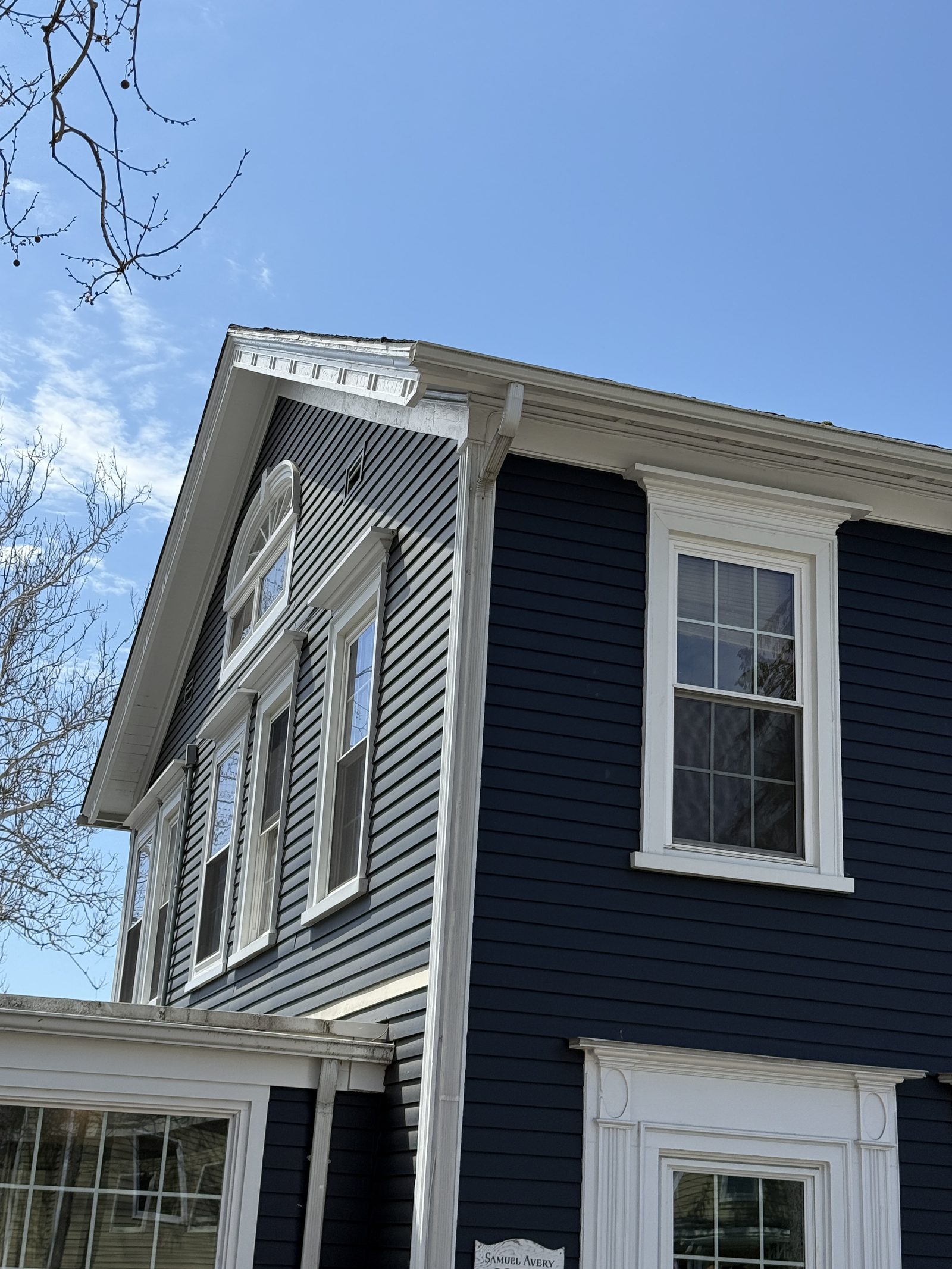
Eastern white pine (Pinus strobus) is native to New England and the Northeast, historically one of the most abundant timber species in the region. For exterior trim — window casings, corner boards, fascia, frieze boards, rake boards — the correct specification is clear or select grade white pine, free of knots that would compromise paint adhesion or structural integrity at thin profiles. Finger-jointed pine is available as a cost-effective trim option but requires excellent primer and paint specification to prevent joint telegraphing.
White pine is dimensionally stable relative to many hardwoods but will move with moisture changes. Exterior trim must be back-primed — sealed on all faces including the back — before installation to minimize moisture uptake from the wall side. It paints well and holds paint long-term if properly primed. It is susceptible to rot in ground contact or in situations where water is trapped. In a well-maintained exterior, white pine trim will last for the life of the building.
White pine is the historically correct trim material for New England buildings from the Colonial period through the early 20th century. Its grain, its paint adhesion, and its workability with hand and machine tools make it the right choice for complex profiles and fine detail. PVC trim is not a substitute for a traditional building. Cellular PVC holds paint but has a different surface character and expands and contracts differently than wood.
Available from lumber yards throughout New England. Specify "clear white pine" for exterior trim profiles. Order primed or prime immediately on delivery — do not leave exterior white pine unprimed. New England has several mills producing white pine from sustainably managed regional forests.
Clear eastern white pine for all exterior trim — window casings, corner boards, fascia, frieze boards, rake boards — on traditional New England residential work. Back-prime all trim before installation. Oil-based primer is preferred for first coat on exterior white pine. Do not use cellular PVC as a substitute where wood character is part of the specification. This is the trim wood the buildings were designed for.
Something missing from the archive?
Suggest a material →