
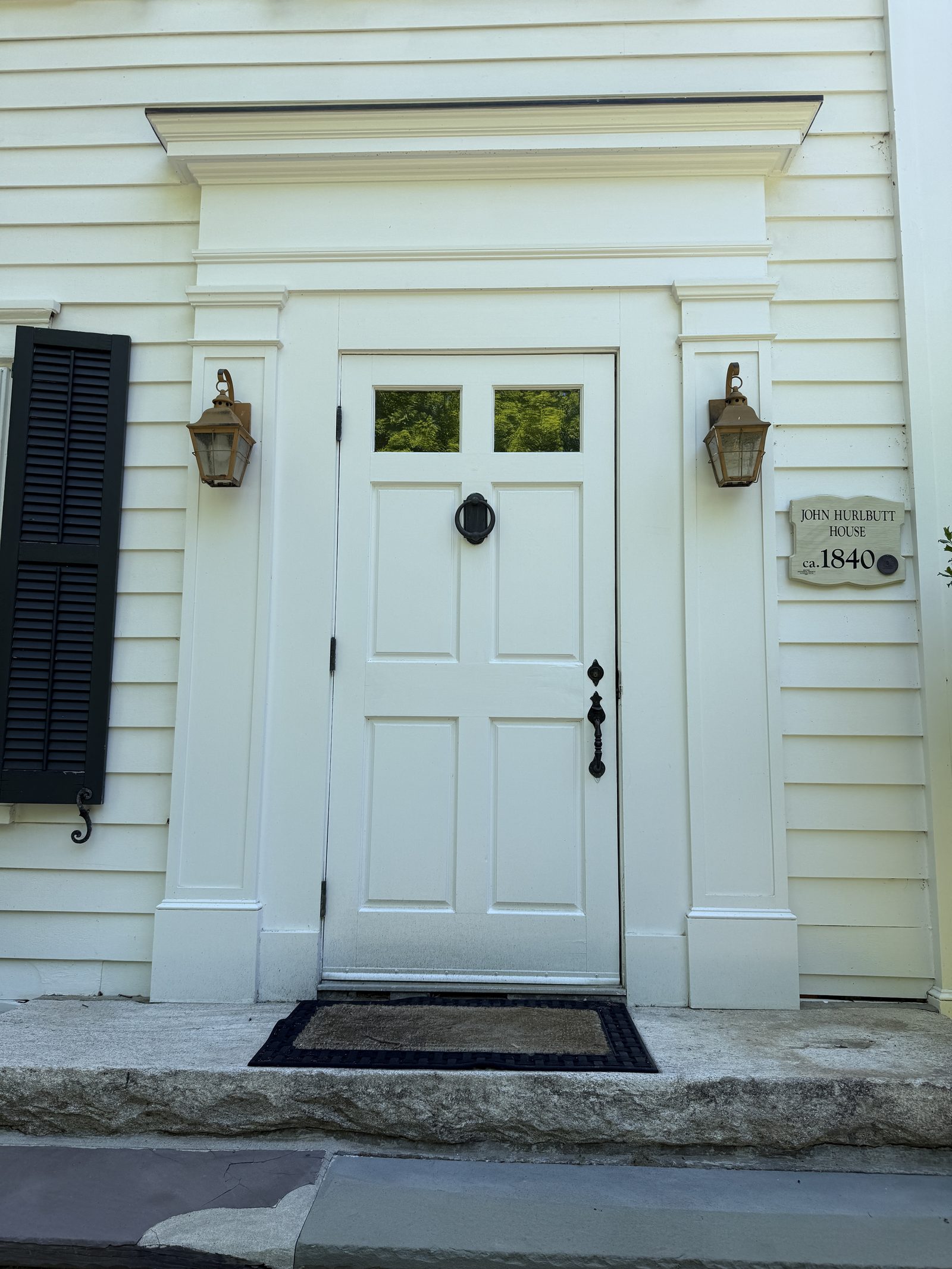
The granite step is one of the most permanent decisions on a traditional New England property. Set correctly, it will outlast the house. The stone exists in sufficient quantity that it is not rare, but the dimensions, the finish, and the setting method distinguish a step that is right from one that only approximates it.
Grey, in the specific grey of New England granite — blue-grey to silver-grey, with the characteristic sparkle of feldspar and mica. The top surface is sawn smooth or thermal-finished for grip, while the front face is often left with a split or sawn texture. The nosing — the leading edge — is slightly bullnosed or left with a clean arris. The color is cool, the mass is obvious, and the step reads as something that was set there a long time ago and will remain.
New England granite steps are cut from local granite quarries — predominantly in New Hampshire (Concord, Conway), Maine (Deer Isle, Barre area), and Vermont. The standard residential entry step is 6 to 7 inches in rise, 14 to 16 inches in tread depth, and a minimum of 5 inches in thickness. Width is typically the full width of the entry, with a minimum of 5 feet for a traditional single-door entry. The sawn top surface is standard. Thermal finish is an alternative with better grip in wet conditions.
Granite steps do not deteriorate in New England conditions. They do not spall in freeze-thaw. They do not stain. They do not require sealing. They accumulate a surface patina over decades — a slight darkening at the edges — that reads as age, not failure. What fails is the setting: steps set directly on grade without a proper base will heave and tip. Steps require a concrete footing below frost depth or a compacted crushed stone base of minimum 12 inches.
Bluestone is the terrace material. Granite is the step material. The distinction is not arbitrary — granite's mass and durability are appropriate for a structural element that is loaded and unloaded thousands of times per year. Bluestone, softer and more prone to edge chipping, is not the right answer at an entry that takes daily impact. Precast concrete steps are not an acceptable alternative on a traditional property.
Order from a stone yard or monument supplier — monument suppliers often have the cleanest-cut granite steps at the most competitive prices. Specify: sawn top, split or sawn front face, bullnose nosing, minimum 5-inch thickness, New England origin granite. Provide exact tread width. Steps are heavy — a 5-foot-wide step at 5-inch thickness weighs approximately 400 pounds. Plan for equipment.
New England granite, sawn top surface, minimum 5-inch thickness, 6-inch rise, 16-inch tread, for entry steps on traditional residential properties. Bullnose nosing. Set on poured concrete footing below frost depth or minimum 12-inch compacted crushed stone base. No precast concrete. No imported granite. The weight and the color and the permanence are the point.
Something missing from the archive?
Suggest a material →