
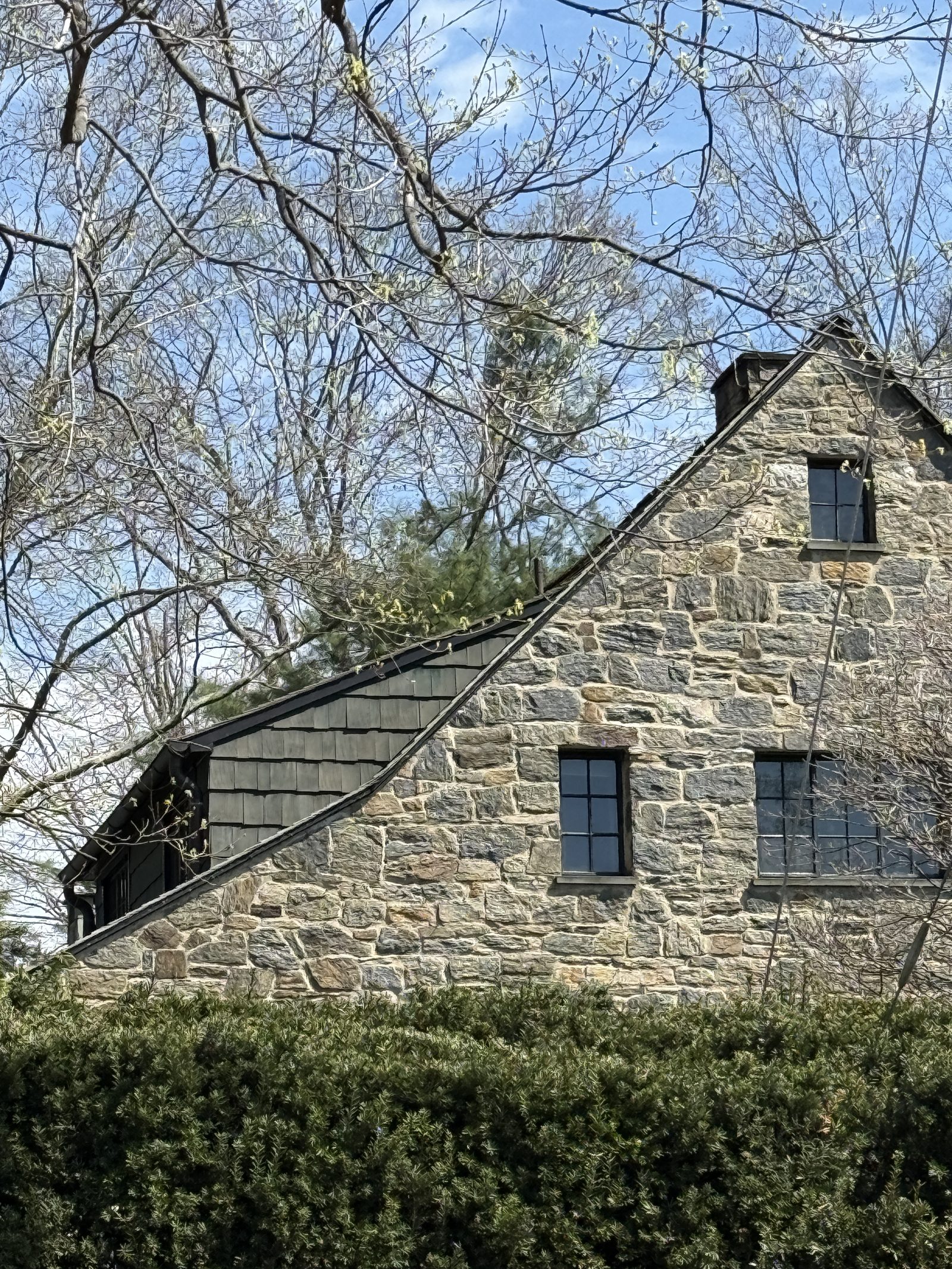
Split a piece of New England fieldstone and you may find it glittering. That is mica — sheets of muscovite or biotite running through the metamorphic stone in parallel planes. Mica schist is one of the most common bedrock types in New England, and it shows up everywhere: in stone walls, in outcropping ledge, in split-face retaining walls, in the stone steps of houses built before 1900.
Silver to grey, with a pronounced foliation — parallel planes that catch light and shift as you move past the stone. In some specimens the mica content is high enough that the face shimmers. In others it is quieter, the foliation visible only when the light rakes across it. The stone splits along its foliation planes, producing naturally flat faces. Veins of quartz run through it in white bands, and the color shifts from blue-grey to silver to pale green depending on mineral content and quarry location.
Mica schist is a metamorphic rock formed from shale or mudstone subjected to heat and pressure during the ancient mountain-building events that produced the Appalachians. It is found throughout New England bedrock, from the Berkshires through Connecticut and Rhode Island and north through Vermont and New Hampshire. The dominant mica minerals are muscovite (silver) and biotite (dark bronze to black). The stone has a grain — foliation — and splits along that grain far more readily than across it.
Mica schist is durable in compression but weaker across its foliation planes than granite. It should not be used in applications requiring high tensile strength across the grain. For wall construction, it is excellent — the flat-bedded character of split schist makes for tight, stable coursing. For steps and treads, it is appropriate when set with foliation horizontal, not vertical. It does not take a polished finish.
Mica schist is the stone of New England outcroppings. It is what comes out of the ground when you dig a foundation in much of Connecticut, Massachusetts, and Rhode Island. Using it for walls and steps and landscape features connects a building to its literal ground. There is no imported material that reads the same way, because the sparkle and the foliation are specific to this geology.
Available from New England quarries and stone yards as split-face wall stone, stepstone, and fieldstone. Ask for "native schist" or "Connecticut schist wall stone." Ledge exposed during site excavation is often usable — have it assessed by your mason before the excavator moves it off site.
Native mica schist, split face, for dry-stack and mortared wall construction and exterior steps on New England properties. Set with foliation planes running horizontally. Steps minimum 5-inch tread thickness, set with foliation parallel to the tread surface. No polished or honed finish. The rough face and natural sparkle are the correct character of this stone.
Something missing from the archive?
Suggest a material →