
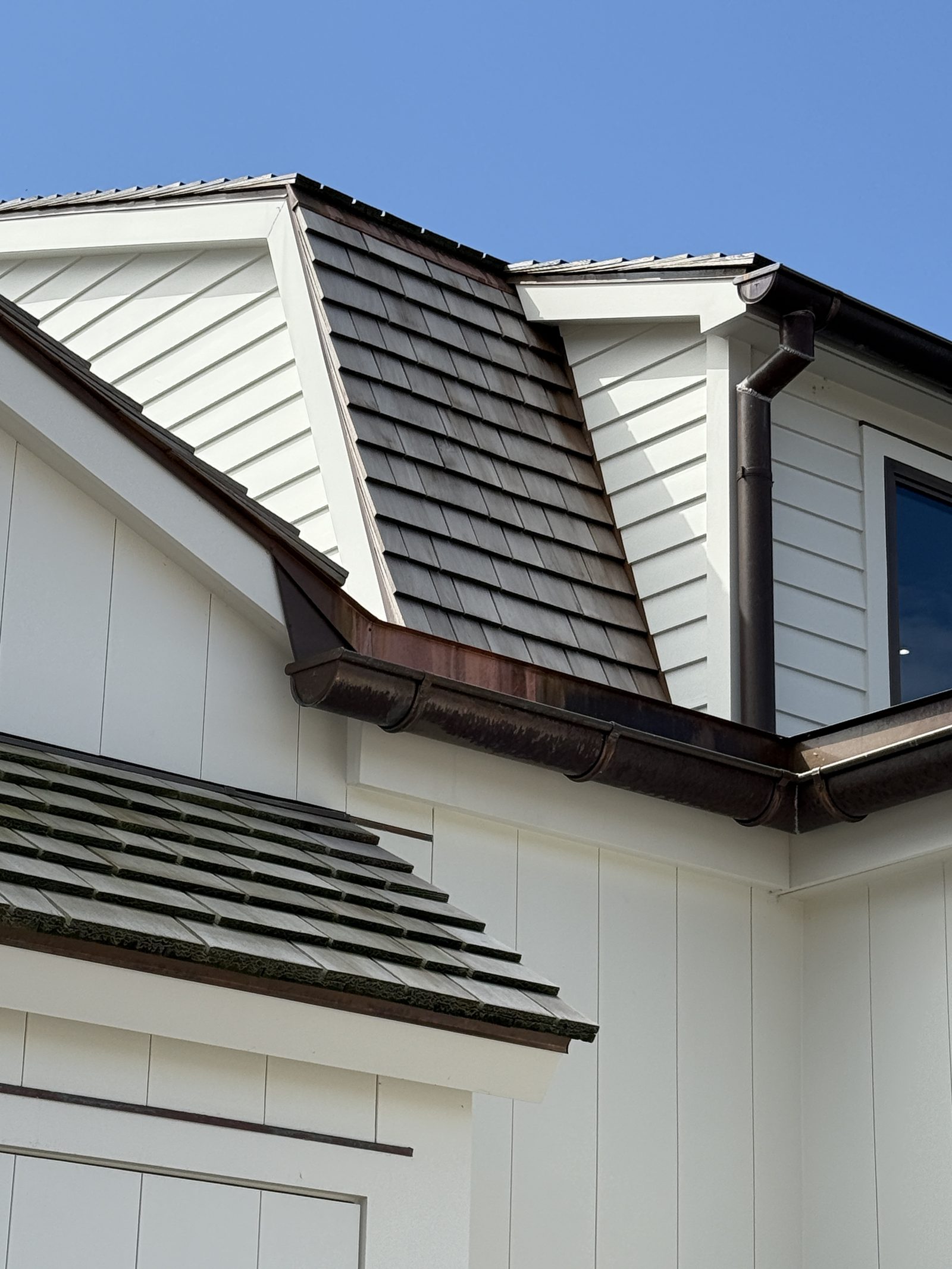
A cedar shake roof on an old New England house is one of the most visually correct things you can put on it. The texture catches light differently at every hour of the day. The surface is never uniform, never flat, never finished-looking in the way that asphalt shingles are finished-looking. It reads as hand-made because it is hand-made, split from straight-grained western red cedar along the natural grain of the wood.
It is also one of the most misspecified roofing materials in traditional residential work. Cedar shake roofing is not cedar shingle siding applied at a different angle. The materials are distinct, the installation requirements are different, and the mistakes made by confusing them are expensive and permanent.
A new cedar shake roof is the color of pale honey. Over the first two seasons it weathers through amber and tan toward a soft grey-brown that is specific to roofing cedar — darker than the silver of wall shingles, with more warmth in the undertone. By year ten it is fully settled into the landscape, reading from the street as a surface that has been there for a long time.
The texture of a shake roof is its defining quality. Hand-split shakes have a roughness that comes from following the grain of the wood rather than cutting across it. This roughness is not imprecision. It is the surface that sheds water, catches shadow, and gives the roof its visual weight. A sawn shake has none of this quality. It reads as flat and commercial even at a distance.
Roofing shakes are almost exclusively western red cedar, not eastern white cedar. The two species weather differently, and western red cedar is the industry standard for roofing applications because of its natural oils, its resistance to moisture, and its dimensional stability under the thermal cycling of a roof.
Shakes come in two types: hand-split and resawn, and tapersawn. Hand-split and resawn shakes are split on one face, sawn on the other, giving them the rough texture on the exposed face that defines the traditional look. Tapersawn shakes are sawn on both faces and are more uniform in appearance. For traditional New England work, hand-split and resawn is the correct specification.
Grade matters significantly. Number One Blue Label is the standard for roofing applications, made from clear, edge-grain wood with no sapwood on the exposed portion. Number Two shakes are acceptable in some applications but carry more variation in quality. On a traditional property, Number One is not a luxury. It is the minimum.
Cedar shake roofing requires a different underlayment system than asphalt shingles. Felt interlay between courses is standard practice — an 18-inch strip of thirty-pound felt laid over the top portion of each course before the next course is applied. This felt interlay is what makes a shake roof weather-tight despite the inherent irregularity of the split wood.
Shake roofs require ventilation. Cedar is a natural material that needs to breathe. A shake roof installed over a solid deck without adequate attic ventilation will deteriorate significantly faster than one installed correctly. The roof needs to dry out between rain events. This requires both the right underlayment system and adequate attic air movement.
Properly installed and maintained, a cedar shake roof will last thirty to fifty years in a New England climate. Improperly installed, or installed without adequate ventilation, it may fail in fifteen. The installation quality matters as much as the material quality.
Asphalt shingles are the dominant residential roofing material in North America because they are inexpensive to install, widely available, and require no particular skill to apply. None of these qualities are relevant to a traditional New England house where the roof is a significant visual element and the assumption is that the building will be maintained over generations rather than replaced on a twenty-year cycle.
A cedar shake roof on a traditional house is not nostalgia. It is the correct material for the application. The texture, the weathering, the visual weight are all specific to this material and cannot be approximated. Synthetic shake products exist and improve each year but none of them, yet, achieve what the real material does on a well-built house.
Specify western red cedar, hand-split and resawn, Number One Blue Label, 24-inch length for most residential applications. Exposure is typically 10 inches on a roof pitch of 4:12 or greater.
Engage a roofing contractor who has installed cedar shake roofing specifically, not one who primarily does asphalt shingles and will apply cedar shakes with the same methods. Ask for references on cedar shake work and inspect those roofs before committing.
Fire treatment is required in most jurisdictions for new cedar shake roofing. Specify Class A fire-rated shakes, which are factory-treated with a fire retardant. This is not optional and does not meaningfully affect the appearance or weathering of the material.
Western red cedar, hand-split and resawn shakes, Number One Blue Label, 24-inch length. Class A fire-rated where required. Installed with 18-inch felt interlay between courses over a properly ventilated attic system. Exposure of 10 inches on pitches of 4:12 or greater. Installed by a contractor with documented cedar shake experience. The texture is the point. Sawn or synthetic substitutes are not the same material.
Something missing from the archive?
Suggest a material →