
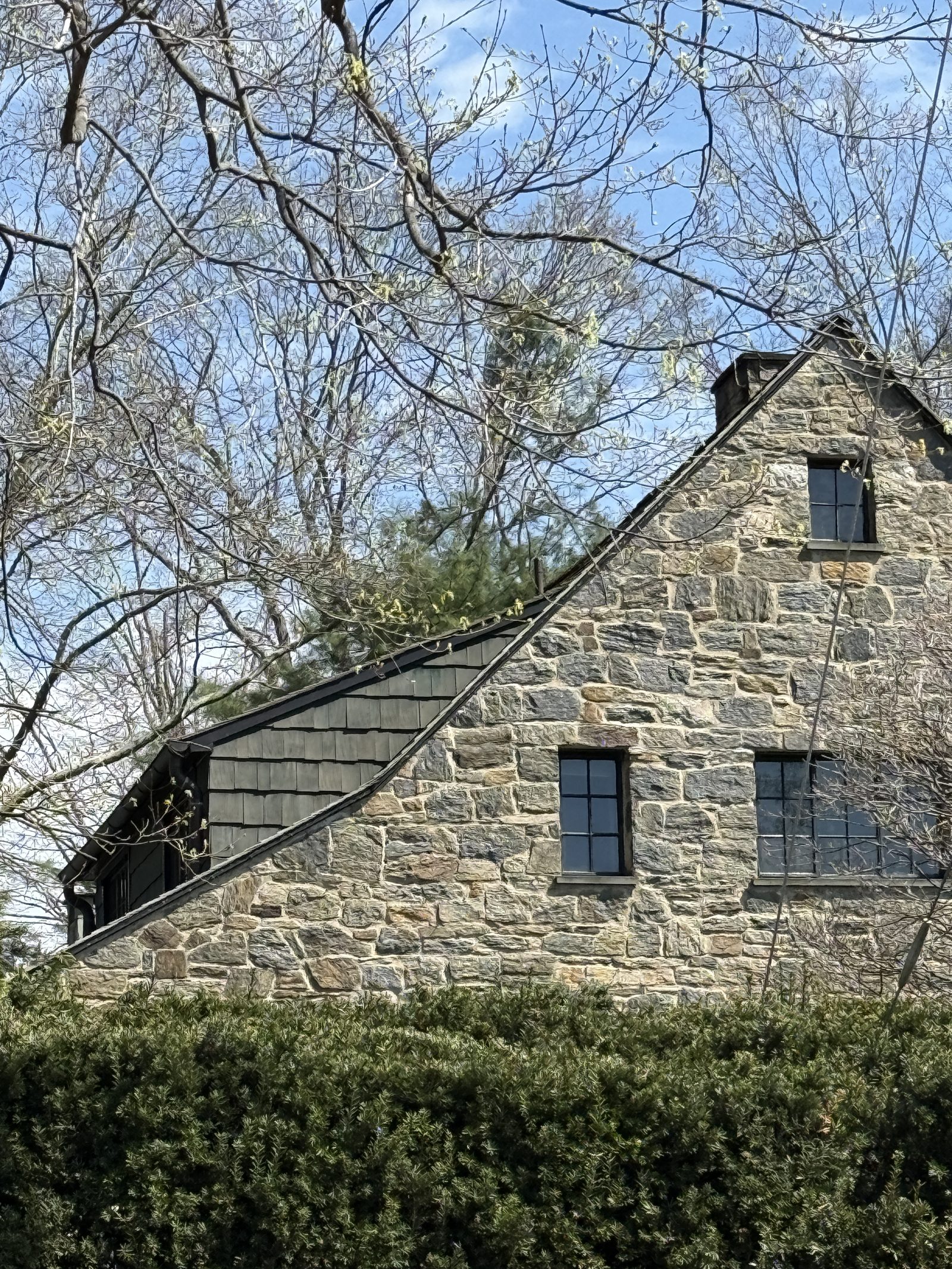
New England is defined as much by its stone walls as by any other single material. They run through forests that were once open fields. They border roads that have been there for three centuries. They were built by hands clearing land for agriculture, and they have outlasted the farms by two hundred years. The dry-stack wall — no mortar, no footing, set stone by stone — is one of the most enduring building technologies in human history.
A good dry-stack wall reads as inevitable. The stones settle into each other as if they were always that way. The face is irregular but not chaotic — there is a coursing to it, a horizontal rhythm, even when the stones themselves are random fieldstone. The top is flat or gently crowned, with larger capstones set to shed water. The whole thing is slightly battered — wider at the base than the top — which gives it its stability and its characteristic profile against a hillside.
Dry-stack construction uses fieldstone, split granite, or quarried stone set without mortar, relying on mass, gravity, and careful interlocking of individual stones for stability. A proper dry-stack wall is double-wythe construction — two parallel faces with rubble fill between — with frequent through-stones crossing both wythes to tie the wall together. Base width is typically 24 to 30 inches for a wall 36 to 48 inches tall. The batter — inward lean of each face — is approximately 1 inch per foot of height.
The dry-stack wall is self-draining. Water moves through it rather than building hydrostatic pressure behind it. In frost, individual stones may shift slightly, but the wall as a system accommodates movement that would crack a mortared wall. A well-built dry-stack wall requires almost no maintenance. What it needs is the occasional reset of a stone displaced by frost or tree roots.
The mortared stone wall looks like a dry-stack wall but behaves entirely differently. It cannot drain. It cannot flex. It cracks at mortar joints and requires repointing on a cycle. In a New England frost environment, the mortared wall is the inferior technology. The dry-stack wall is not a rustic approximation of something better. It is the correct engineering solution for the climate.
Dry-stack walling is a craft skill. Find a mason with specific experience in dry-stack construction — not every stone mason builds dry. Ask to see existing work, and look for walls with consistent batter, flat caps, and visible through-stones. Material is local fieldstone — available from land clearing operations, stone dealers, and wall dismantling projects. Specify fieldstone by character: flat-bedded, minimum 4-inch thickness, no round cobbles.
Double-wythe dry-stack construction, local fieldstone, minimum 24-inch base width for a 36-inch wall. Through-stones at maximum 4-foot spacing horizontally, every other course vertically. One-inch batter per foot of height on each face. Flat capstone course, minimum 6-inch thickness. No mortar. This is the correct wall for New England.
Something missing from the archive?
Suggest a material →